



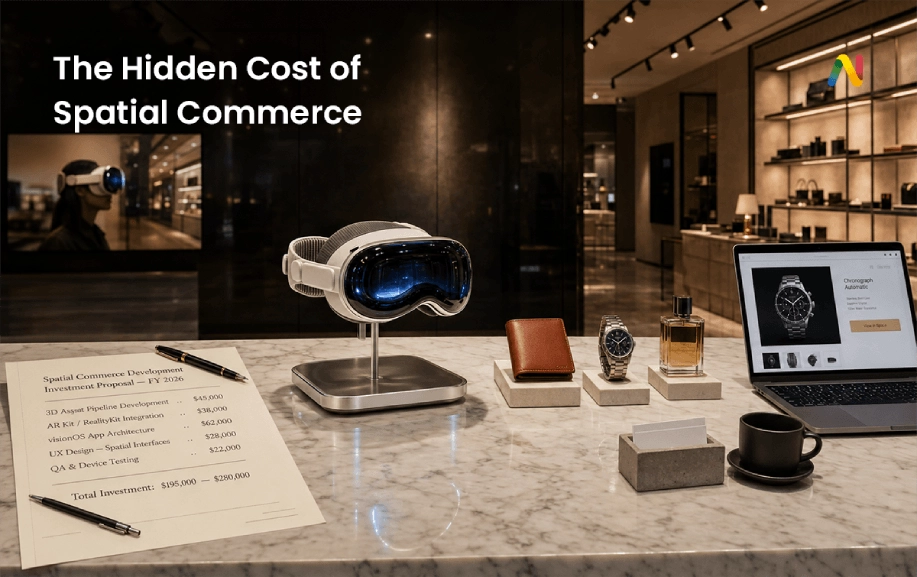
Online shopping has a massive problem: high return rates because customers can't visualize the product. Spatial Commerce solves this. As a leading E-commerce app development company, we help global retailers build Vision Pro apps that let customers "try before they buy" in stunning 3D. Imagine seeing a new couch in your living room or trying on a pair of glasses from your couch. This is the future of retail in 2026. If you want to stay ahead, you need to understand how much it costs and how to build it.
What is Spatial Commerce and Why Retailers Need It?
Spatial Commerce is the next big step for selling things online. For years, we looked at flat photos on a screen. Then we got videos. Now, we have 3D. Spatial Commerce turns your home into a store. Using a smart device like the Apple Vision Pro, you can see products as if they are right in front of you.
Retailers need this because it builds trust. When a customer can see the size and colour of a lamp on their own desk, they are more likely to buy it. They are also less likely to send it back. This saves the store money on shipping and returns. In the world of Spatial computing solutions, the goal is to make digital items feel real. By creating an Immersive shopping experience, brands can connect with people in a way that a simple website never could.
The Problem with 2D shopping
Traditional websites are limited. You can zoom in on a photo, but you can't see how a table fits next to your bed. You can't walk around it. This "guessing game" leads to millions of dollars in lost sales. A Website development company that only builds flat pages is missing out. To win in 2026, you must offer more.
The Power of Presence
When you use a Vision Pro app, the product has "presence." It casts shadows on your floor. It reflects the light in your room. This level of detail makes the customer feel like they already own the item. This is why Virtual try-on (VTO) technology is changing everything from fashion to home decor.
The Cost to Build an AR Shopping App for Apple Vision Pro
Building for the Vision Pro is not the same as making a phone app. It requires new tools and a new way of thinking. Because of this, the costs can vary based on what you want the app to do.
Estimated Development Costs (2026)
To get the best results, you need to hire dedicated developers who know how to work with spatial data. A simple app might just show a menu in the air. A complex app lets you open drawers on a virtual dresser or change the fabric on a chair with a pinch of your fingers.
Why the Price Varies?
The highest cost is the "logic density." This means how much the app has to "think" to make things look real. If you want the app to track a user's hands perfectly, it takes more work. If you want it to remember where a lamp was placed even after the user walks away, you need advanced visionOS SDK development. This is why you should hire Vision Pro developers who have a deep background in AR.
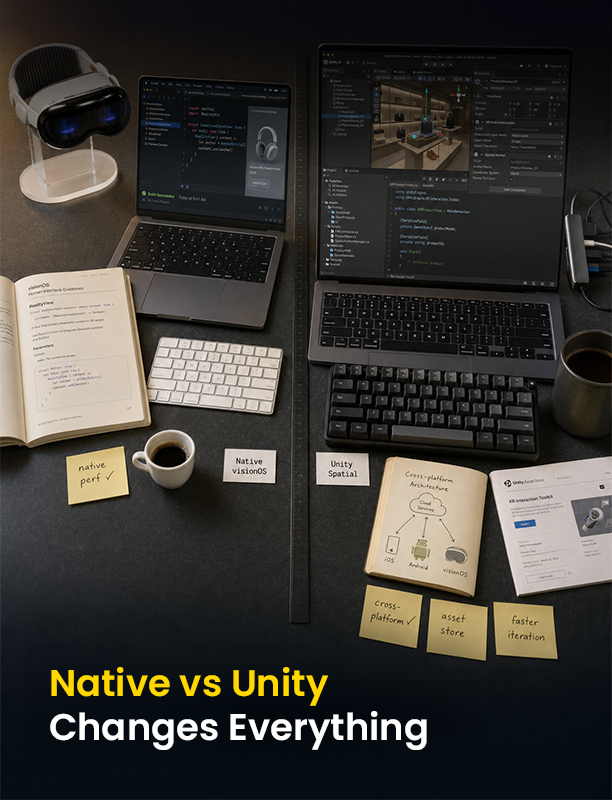
Native visionOS vs Unity: Which is Better for E-commerce?
When you start your project, you have a big choice. Do you use Apple's own tools, or do you use a game engine like Unity? This is the Unity vs Native Swift for AR debate.
Going Native with Swift and SwiftUI
Apple recommends using Native Swift and SwiftUI. This allows for the best performance. It makes the app feel like a part of the Vision Pro system. Native apps are usually faster and look sharper. They also use RealityKit and ARKit integration to handle lighting and physics. If your goal is a high-end luxury experience, native is the way to go.
Using Unity for Cross-Platform Reach
Unity is a great choice if you already have a 3D app on other headsets like the Meta Quest. It allows you to build once and share everywhere. Unity is very powerful for games and complex 3D animations. However, it might not feel as "smooth" as a native Apple app.
For most e-commerce brands, we suggest native development. It allows for better AR app development services because it taps into the heart of what makes the Vision Pro special.
The Hidden Costs of 3D Asset Rendering for Spatial Commerce
Coding the app is only half the battle. You also have to turn your physical inventory into 3D objects. This is called a 3D product rendering pipeline. You can't just take a photo and put it in the headset. It has to be a "digital twin."
The 3D Pipeline Explained.
- Photogrammetry: You take hundreds of photos of a product from every angle.
- USDZ Conversion: A computer blends those photos into a single 3D file format that Apple devices love.
- RealityKit Rendering: The app uses this engine to make the model look real in the user's room.
If you have 1,000 products, this can get expensive. Converting standard photos into photorealistic models takes time and skill. This is why you must hire dedicated developers who understand the art of 3D modeling, not just code.
Why You Need to Hire an E-Commerce App Development Company for AR
You might think your current web team can handle this. But spatial Commerce is different. It's like moving from drawing on paper to building with blocks. A traditional Website development company might know how to make a checkout button, but do they know how to handle 3D physics?
An experienced E-commerce app development company understands the whole journey. They know how to connect your 3D app to your existing store, like Shopify or Magento. They also provide specialised AR app development services to make sure the app doesn't crash when a user tries to view a large 3D file.
Specialized Skills
Building for Vision Pro requires knowing:
- How to design for eyes and hands (not a mouse).
- How to optimise 3D files so they load fast.
- How to use the visionOS SDK development tools to their full potential.
From 2D to 3D: Upgrading Your Website Design Agency Strategy
Your Website design agency needs to stop thinking in terms of "pages." In the Vision Pro, there are no pages, only spaces. Designing for eyes and hands is a whole new world. Instead of clicking a button, a user looks at an object and pinches their fingers.
This is called "Eye Tracking" and "Gesture Control." If your design is too cluttered, the user will get frustrated. You need support from a Website design agency that can map out intuitive spatial UI. This means placing menus where they are easy to reach but don't block the view of the product.
Moving Beyond the Flat Catalogue
The goal is to move from a flat list of items to a gallery you can walk through. Instead of scrolling down, the user walks forward. This change in strategy is what creates a truly
Immersive shopping experience.
Build the Next Generation of Retail with Netclues
Spatial Commerce is reshaping how customers discover, evaluate, and purchase products. Whether you're planning a Vision Pro shopping app, modernizing your eCommerce platform, or exploring immersive retail experiences, the right strategy and technical expertise can make all the difference.
Partner with Netclues to design, develop, and scale secure, high-performance Spatial Commerce solutions tailored to your business goals. From visionOS development and 3D asset pipelines to Shopify and Magento integrations, our team helps you create immersive shopping experiences that drive engagement, improve conversions, and prepare your business for the future of digital commerce.
Conclusion: Don't Get Left Behind
Spatial computing is the new smartphone. If you aren't building for the Vision Pro today, you will be left behind tomorrow. The technology is here, and customers are ready for it. Stop relying on flat 2D catalogs that lead to high returns.
It is time to embrace the future. Whether you need a simple windowed app or a fully immersive world, the right partner makes all the difference. You need a team that can handle everything from the 3D product rendering pipeline to the final RealityKit and ARKit integration.
Hire our dedicated developers to architect your immersive spatial commerce platform and dominate the 2026 retail landscape. We provide the Spatial computing solutions you need to grow your brand and delight your customers.
Ready to start your journey into Spatial Commerce? Visit Netclues to find the experts you need. From E-commerce app development company services to custom AR app development services, we have you covered. Let's build the future of shopping together!
Frequently Asked Questions (FAQs)
Q.1. How much does it cost to build a Vision Pro shopping app?
The cost to develop a Vision Pro shopping application typically ranges from $40,000 to over $150,000, depending on features, 3D asset creation, integrations, immersive interactions, and platform complexity. Ongoing maintenance, optimization, and content updates should also be considered when planning the overall project budget.
Q.2. What is Spatial Commerce?
Spatial Commerce is an immersive form of e-commerce that uses spatial computing, augmented reality, and 3D visualization to allow customers to interact with lifelike digital products in their own environment before making a purchase decision.
Q.3. Why do retailers invest in Spatial Commerce?
Retailers invest in Spatial Commerce to improve product visualization, increase customer confidence, reduce purchase uncertainty, lower return rates, and create differentiated shopping experiences that improve engagement and conversions.
Q.4. Can Netclues help build a complete Spatial Commerce solution?
Yes. Netclues supports the complete Spatial Commerce development lifecycle, including strategy planning, UX design, Apple Vision Pro and visionOS development, 3D product workflows, e-commerce integrations, testing, optimization, and ongoing improvements based on business requirements.
Q.5 How do I know if my business is ready for Spatial Commerce?
Businesses with products where size, appearance, placement, customization, or user experience influence buying decisions are strong candidates for Spatial Commerce. Industries such as furniture, fashion, luxury goods, electronics, automotive, and home products can benefit significantly from immersive shopping experiences.
Q.6. Can I start with a small Spatial Commerce MVP?
Yes. Many businesses begin with a focused Spatial Commerce MVP featuring a limited product catalog, essential AR interactions, and core e-commerce integrations. This approach helps validate customer adoption, measure engagement, and expand into a larger immersive commerce ecosystem over time.
Q.7. How much does a Vision Pro shopping app cost?
Most Vision Pro shopping applications cost between $40,000 and $150,000 or more, depending on the complexity of features, integrations, 3D product requirements, user interactions, and the level of immersion required.
Q.8. What technologies are used to build Vision Pro shopping apps?
Vision Pro shopping apps typically use technologies such as visionOS SDK, Swift, SwiftUI, RealityKit, ARKit, USDZ 3D models, spatial computing frameworks, and optimized 3D rendering pipelines to create realistic shopping experiences.
Q.9. Does Spatial Commerce reduce product returns?
Yes. By allowing customers to visualize products at actual scale and see how they fit within their real environment, Spatial Commerce reduces purchase uncertainty and can help businesses lower product return rates.
Q.10. How long does it take to build a Spatial Commerce application?
Development timelines depend on the project's complexity. A basic Spatial Commerce MVP may take a few months, while advanced applications with custom 3D assets, immersive interactions, and enterprise integrations may require a longer development cycle.
Q.11. Can Spatial Commerce integrate with existing e-commerce platforms?
Yes. Spatial Commerce applications can integrate with existing e-commerce platforms, product catalogs, inventory systems, customer management tools, payment solutions, and backend services to create a connected shopping experience.
Q.12. Which industries benefit most from Spatial Commerce?
Industries that benefit most from Spatial Commerce include furniture, interior design, fashion, luxury retail, automotive, electronics, real estate, manufacturing, home decor, and consumer product businesses where visualization plays an important role in purchase decisions.