


Have you recently felt that, though your SaaS company ranks on page one of Google, your leads are dropping? If so, it is time to acknowledge that your target audience is asking ChatGPT and Perplexity for software recommendations, and that your brand isn't being mentioned. The digital landscape has shifted to an extreme level.
In 2026, the traditional search engine results page (SERP) is no longer the only single place where customers get to find answers. They are now turning to AI-powered chatbots and generative engines to make buying decisions.
As a leading website development company, we are helping global enterprises pivot to Generative Engine Optimization (GEO) to ensure they stay visible in this new era of artificial intelligence.
The trend is undeniable: we are moving from SEO to GEO. It is no longer enough to be "searchable." Your brand must be "citeable." If an AI doesn't include your product in its generated answer, you effectively do not exist to a massive segment of your market.
What is Generative Engine Optimization (GEO)?
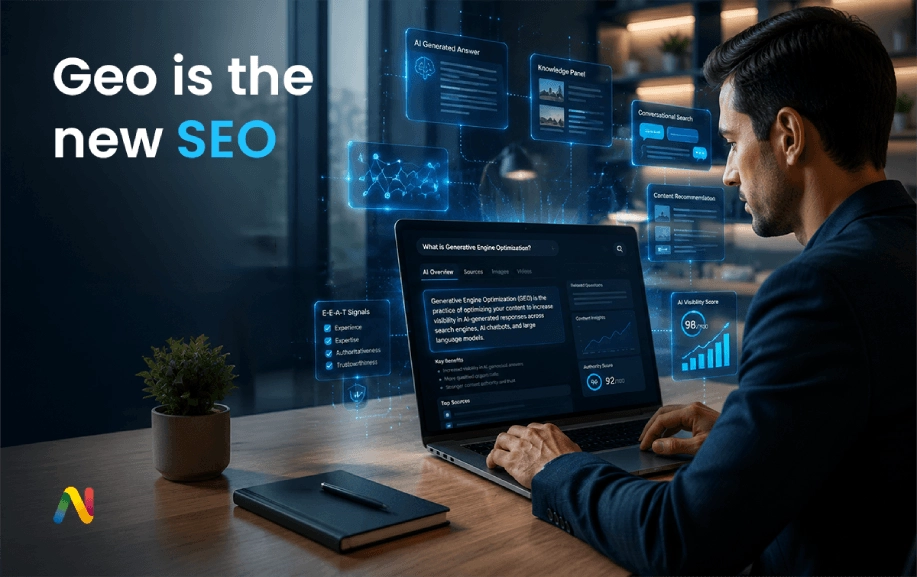
Generative Engine Optimization (GEO) is the complete process of optimizing a website and its digital footprint so that its brand, products, and content are highly cited as primary sources by AI chatbots and generative search engines.
Think of it as the next evolution of digital marketing. While SEO was about helping a search engine "index" your site, GEO is about helping an AI understand and recommend your site.
When a user asks an AI the big question, "What is the best project management tool for small teams?" the AI doesn't just show a list of links. In fact, it writes a paragraph explaining why certain tools are better than others.
It then provides citations, small links, or footnotes that show where it got that information. A Generative Engine Optimization agency focuses on making sure your brand is the one the AI chooses to talk about.
The Core of GEO
At its heart, GEO relies on two main things: clarity in data and authority. AI models, like those behind ChatGPT brand mentions and Perplexity SEO strategy, are looking for facts they can trust. They use Retrieval-Augmented Generation (RAG) systems to retrieve information from the web in real time. If your website is structured in a way that these systems can easily digest, you are much more likely to be featured in the final response.

Traditional SEO vs. GEO: Why are keywords no longer enough?
For twenty years, keywords were king. If you put "best coffee maker" on your page enough times and got enough links, you would rank for it. But in 2026, that strategy is failing. AI models are smarter than simple keyword matching. They understand concepts, context, and the relationships between different entities.
The 3 Key Differences
1. The Goal: Clicks vs. Citations Traditional SEO optimizes for clicks and rankings on a SERP. The goal is to get the user to click a blue link and land on your page. GEO, however, optimizes for citations and brand mentions directly within an AI's conversational answer. In a GEO world, the "win" is having the AI say, "According to [Your Brand], the best way to solve this problem is..." Even if the user doesn't click, your brand has gained authority and mindshare.
2.The Audience: Humans vs. LLMs SEO writes for human search intent by answering the questions people type into boxes. GEO structures data specifically for Large Language Models (LLMs). This means your AI SEO optimization services must focus on how a machine reads your site. While the content must still be readable for humans, the underlying structure must be perfect for an AI to parse.
3.The Tactic: Backlinks vs. Entity Optimization SEO relies heavily on keyword density and the number of backlinks pointing to a page. GEO relies on Entity-based SEO, Knowledge Graph optimization, and dynamic JSON-LD schema markup. An "entity" is a person, place, or thing that an AI recognizes. If the AI views your brand as a "Trusted Entity" in the Knowledge Graph, it will recommend you more often.
How to get your brand mentioned by ChatGPT and Perplexity?
To get mentioned by AI engines like ChatGPT, Perplexity, and Google AI Overviews optimization, you need a strategy that proves your expertise to a machine. This isn't about "tricking" the algorithm; it's about being the most helpful and clear source of information available.
LLM Citation Strategy
An effective LLM citation strategy involves creating "high-density information zones." AI models prefer content that provides direct, factual answers to specific questions. To increase your chances of being cited:
- Use Clear Headings: Use Semantic HTML architecture to tell the AI exactly what each section of your page is about.
- Provide Data and Statistics: LLMs love numbers. If you provide original research or data points, the AI is more likely to cite you as the source of that data.
- Be a Definitive Source: Instead of writing "We think X is good," write "X is the industry standard for Y because...
Perplexity and Google AI Overviews
Systems like Perplexity and Google's AI Overviews are "connected" to the live web. They browse the internet to find the most recent information. To win here, your site needs to be fast and technically sound. This is why many brands hire technical SEO experts to ensure their sites' technical foundations don't block AI crawlers.
Why does GEO require you to hire dedicated developers for schema markup?
Many businesses make the mistake of thinking that GEO is just a content-writing job. It isn't. It is a coding job. For an AI to read accurately, a website needs a flawless technical structure that goes far beyond what a standard SEO writer can provide.
The Technical Reality: Coding for AI
To be featured in an AI response, your website needs to "speak" the language of machines. This is done through advanced schema markup and Semantic HTML architecture.
When you hire dedicated developers, they do more than make the site look good. They build a map of your website that tells AI models exactly how different pieces of information relate to each other. This is often called "Entity-Relationship Mapping." For example, a developer can use schema to tell an AI: "This is a product, this brand created it, it solves this specific problem, and here are five expert reviews proving it."
Without this invisible layer of code, an AI might "hallucinate" or guess what your site is about. By providing clear, structured data, you remove the guesswork and make it easy for the AI to cite you. This is why a professional website development company is now a vital part of any marketing team.
Cost of Generative Engine Optimization Services in 2026
Budgeting for AI SEO optimization services differs from budgeting for traditional SEO. In 2026, the costs are split between content creation, data engineering, and technical maintenance.
- Initial Audit and Strategy: An Generative Engine Optimization agency will first perform a "brand gap analysis." They look at what AI currently says about you and where you are missing.
- Technical Restructuring: This is usually the highest upfront cost. It involves rewriting your site's code to support a Semantic HTML architecture and complex schemas.
- Ongoing Entity Management: You must constantly update your entity footprint across the web. Managing the entity footprint includes maintaining your presence on credible sites such as Wikipedia, LinkedIn, and industry-specific databases that feed into the Knowledge Graph.
While the cost of GEO can be higher than a basic SEO package, the cost of not doing it is even higher. If your competitors are the only ones appearing in ChatGPT or Google AI Overviews, they will capture the entire market before a user even sees a traditional search result.
From Clicks to Citations: Upgrading Your Website Design Strategy
In the world of GEO, your website design must serve two masters: the human visitor and the AI crawler. A premier website design agency builds a site architecture that proves authority to machine learning models while staying user-friendly.
Deep Dive into Authority Positioning: Beyond Keywords
Startups often think they can trick AI with a few clever blog posts. However, LLMs prioritize E-E-A-T (Experience, Expertise, Authoritativeness, and Trustworthiness). They are programmed to penalize keyword stuffing and "thin" content.
To build real authority, your website design must highlight your credentials. This includes:
- Expert Author Bios: Linking authors to their other works and social profiles to prove they are real humans with expertise.
- Structured FAQ Sections: Using the FAQ schema so AI engines can pull direct answers for their conversational responses.
- Citation-Rich Content: Paradoxically, by citing other experts on your site, you show the AI that you are part of a trustworthy network of information.
Upgrading your strategy means moving away from "How can I rank for this keyword?" to "How can I become the most trusted source of truth for this topic?" When you hire technical SEO experts and developers, they ensure that this authority is baked into every line of code on your site.
Conclusion: Future-Proof Your Brand with GEO
The era of the ten blue links is ending. The way people find information has changed forever. If ChatGPT doesn't know who you are, or if Perplexity doesn't recommend your product, you don't exist to the next generation of B2B and B2C buyers.
Stop fighting for the scraps of traditional search clicks and start dominating the world of AI citations. Generative Engine Optimization is not a "luxury" service for the future, it is a survival requirement for today. By focusing on Entity-based SEO, Knowledge Graph optimization, and a solid LLM citation strategy, you can ensure that your brand remains the top choice for both humans and machines.
Don't let your business get left behind in the pre-AI era. It is time to rebuild your digital presence for the world of 2026.
Ready to dominate the AI search era? Stop relying on outdated tactics. Hire our dedicated developers today to future-proof your website with a custom GEO strategy. At Netclues, we combine technical brilliance with marketing foresight to keep you at the top of every conversation.
Contact Netclues today, and let's make sure the world's most powerful AI engines are talking about you.
Key Takeaways
- GEO helps AI systems understand and recommend your business.
- Traditional SEO alone is no longer enough for AI-driven search.
- Structured data, entity optimization, and semantic SEO are essential for AI visibility.
- Building topical authority improves the likelihood of AI citations.
- Investing in GEO today prepares your brand for the future of search.
Frequently Asked Questions About Generative Engine Optimization (GEO)
Q.1. What is Generative Engine Optimization (GEO)?
Generative Engine Optimization (GEO) is the practice of optimizing your website, content, structured data, and digital presence so AI-powered search engines like ChatGPT, Google AI Overviews, Gemini, Claude, and Perplexity can understand, cite, and recommend your business. Unlike traditional SEO, GEO focuses on AI visibility rather than just search rankings.
Q.2. How is GEO different from traditional SEO?
SEO helps webpages rank in search engine results, while GEO helps AI models retrieve and reference your content in generated answers. GEO emphasizes entity optimization, structured data, semantic relationships, topical authority, and machine-readable content instead of relying primarily on keywords and backlinks.
Q.3. Why is Generative Engine Optimization important in 2026?
As more users rely on AI assistants instead of traditional search engines, brands that aren't referenced by AI risk losing visibility and potential customers. GEO ensures your business remains discoverable across AI-driven platforms where purchasing decisions increasingly begin.
Q.4. Which AI platforms benefit from GEO?
A well-executed GEO strategy improves visibility across ChatGPT, Google AI Overviews, Google Search, Gemini, Claude, Perplexity AI, Microsoft Copilot, and other AI-powered search experiences. Many GEO best practices also strengthen your traditional SEO performance.
Q.5. How can my business get mentioned by ChatGPT or Perplexity?
The best way is to publish authoritative, well-structured content supported by schema markup, semantic HTML, clear entities, expert authorship, trustworthy citations, and consistent information across the web. AI systems prioritize reliable, structured, and credible sources.
Q.6. Does schema markup improve AI search visibility?
Yes. Schema markup provides structured information that helps AI systems accurately interpret your content. While schema alone doesn't guarantee AI citations, it significantly improves machine readability and supports better content understanding across modern search platforms.
Q.7. What industries benefit the most from GEO?
Nearly every industry can benefit, especially SaaS, healthcare, finance, legal services, education, manufacturing, ecommerce, hospitality, travel, B2B services, technology companies, and professional service firms where trust and expertise influence purchasing decisions.
Q.8. How long does it take to see results from GEO?
Initial technical improvements can often be completed within a few weeks, but building authority and increasing AI citations usually takes several months. The timeline depends on your website quality, competition, content depth, technical implementation, and overall digital authority.
Q.9. What does a Generative Engine Optimization service include?
A comprehensive GEO service typically includes AI visibility audits, entity optimization, schema implementation, semantic content strategy, technical SEO improvements, knowledge graph optimization, content restructuring, authority building, and ongoing monitoring of AI brand mentions.
Q.10. What are the biggest mistakes businesses make with GEO?
Common mistakes include relying only on keywords, publishing thin content, ignoring structured data, lacking topical authority, using inconsistent brand information, neglecting technical SEO, and failing to establish expertise through credible, evidence-backed content.
Q.11. Is investing in GEO worth the cost?
For businesses competing online, GEO can deliver long-term value by increasing AI visibility, strengthening brand authority, improving qualified traffic, and supporting future search behavior. Early adoption may also provide a competitive advantage as AI-powered discovery continues to grow.
Q.12. How can Netclues help with Generative Engine Optimization?
Netclues combines website development, technical SEO, structured data implementation, entity optimization, semantic content strategy, and AI search best practices to help businesses improve visibility across both traditional search engines and AI-powered search experiences