



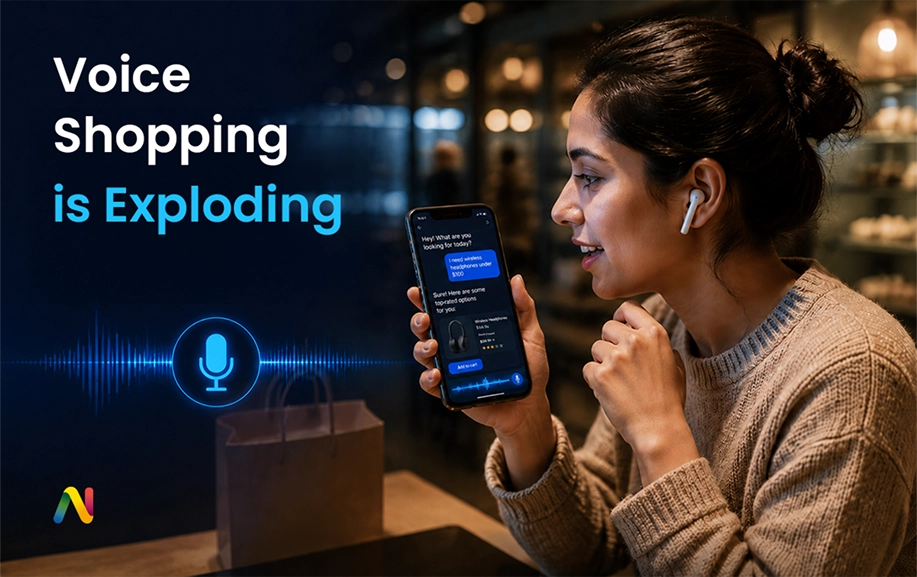
One of the most ironic realities that we are witnessing with the coming of advanced technology is that attention spans are shrinking, and endless scrolling is killing conversion rates. If a user has to click six different filters, such as size, color, price, material, brand, and shipping, to find a product, you've already lost them.
Moreover, in the quick-moving world of digital retail, friction has become the greatest enemy of profit. Hence, it is important to seek help from a leading website development company. Such credible partners are helping global retailers transition to Voice Commerce 2.0. This isn't just about voice search anymore, and it's about a complete shift from clicking boxes to having a real conversation with a store.
The trend is clear: users are no longer patient enough to browse through hundreds of pages. Instead, they are asking AI, "Find me a red dress under $50," and expecting the perfect result instantly. If your store can't listen, it can't sell.
Voice Commerce 2.0: Why "Conversational Shopping" is Replacing UI Filters?
For years, the gold standard of online shopping was "faceted search." You know the one, a long sidebar of checkboxes that let you narrow down your choices. But as we move into 2026, those sidebars are starting to look like relics of the past. Enter Conversational AI for e-commerce.
Voice Commerce 2.0 is the evolution of the shopping experience. While version 1.0 was mostly about "Reorder paper towels" via a smart speaker, version 2.0 is about discovery. It uses Natural Language Processing (NLP) shopping techniques to understand complex human intent.
When a customer says, "I need something fancy for a summer wedding in Tuscany that isn't too expensive and matches silver heels," a traditional filter system breaks. It doesn't know what "Tuscany style" means. But an AI shopping assistant integration can process that request, look at the weather in Italy, check your inventory for breathable fabrics, and present a curated selection.
A sneak peak on the Major Shift to Zero-UI Commerce
We are entering the era of Zero-UI commerce. This doesn't mean the screen disappears; rather, the interface becomes invisible until it's needed. Instead of navigating a maze of menus, the user interacts via voice or text. This requires a massive shift in how you think about your digital presence. To stay ahead, many brands hire dedicated developers who understand how to build invisible interfaces that feel like magic to customers.

How to optimize your e-commerce app for voice search?
Optimization in the 2.0 era goes much deeper than just adding a microphone icon to your search bar. It requires a fundamental rethink of your data structure.
Semantic Search Upgrades:
Most search bars use keyword matching. If a user types "red dress," the system looks for the words "red" and "dress." However, Semantic product search looks for meaning. It understands that "crimson gown" and "red dress" are essentially the same thing. To implement this, your website development company needs to upgrade your backend from basic Elasticsearch to an AI-driven vector search engine. This allows the system to understand context and intent.
Long-Tail Product Descriptions
People talk differently from the way they type. In a search bar, a user might type "men's running shoes." Via voice, they might say, "What are the best lightweight sneakers for someone with flat feet who runs on trails?" To capture this traffic, you must implement voice search optimization (VSO) for your product metadata. Your descriptions should include natural language phrases and answers to common questions.
Headless Commerce Architecture
Speed is everything in voice commerce. If a user asks a question and has to wait five seconds for a page to load, the experience is ruined. This is why Headless commerce architecture is becoming the industry standard. By decoupling your frontend (the "head") from your backend data, your AI modules can pull inventory data, pricing, and images instantly without loading a full webpage. This creates a snappy, "live" feel to the conversation.
Integrating AI shopping assistants into a Shopify store. Shopify is the backbone of millions of stores, but out-of-the-box themes aren't usually ready for Voice 2.0. To truly compete, you need more than just a plugin.
The Problem with Basic Plugins
You might find a "voice search" plugin in the Shopify App Store, but these are often limited in scope. They can't remember that a customer bought a blue shirt last month and now wants "something to match it." True conversational shopping requires a memory and a personality.
The Role of a Shopify development agency
There is a massive role played by a professional Shopify development agency, which can help you integrate advanced APIs such as OpenAI's GPT-4 or Google Dialogflow directly into your Shopify Liquid code. This allows the AI to:
- Access the customer's order history for personalized suggestions.
- Update carts via voice commands.
- Handle complex customer service queries (e.g., "Where is my order?").
When you hire AI app developers, they can build custom middleware that bridges the gap between Shopify's API and the AI's brain, ensuring that real-time inventory levels back every recommendation.
The UX/UI Reality: Designing for the Voice-First Era
Why Does Your Website Design Agency Need a New Playbook?
Voice commerce isn't just a backend task; it changes how the screen looks and behaves. When a user speaks, the UI needs to be dynamic. Imagine a user saying, "Show me those dresses in blue." A traditional site would refresh the whole page. A Voice 2.0 site, designed by a forward-thinking website design agency, would use "Dynamic UI" to swap the colors of the items on the screen instantly, without a reload. The interface "listens" and adapts in real-time. This is the heart of Zero-UI commerce, an interface that follows the conversation, not the other way around.
The cost to build a conversational AI for retail apps
"How much will this cost?" is the first question every retail brand asks. The answer depends on the depth of the integration.
- Level 1: Basic VSO (Voice Search Optimization). This involves updating your metadata and adding basic voice-to-text search. This is relatively affordable and can be handled by a standard E-commerce app development company.
- Level 2: AI Assistant Integration. This involves adding a chatbot or voice bot that can answer varied questions by smartly using Natural Language Processing (NLP) and shopping logic.
- Level 3: Full Conversational Ecosystem. This is one of the most iconic solutions, featuring a Headless commerce architecture, a custom AI brain that learns from user behavior, and a fully dynamic UI.
While the upfront cost is higher, the ROI comes from increased conversion rates and higher average order values. Customers who use voice search are often further along in the buying journey, they know what they want; they need you to find it for them. To get an accurate quote, you should hire dedicated developers who can audit your current tech stack and provide a roadmap.
Why you need to hire an e-commerce app development company for NLP
It is tempting to try to build these features in-house or use a generic "AI builder." However, e-commerce has specific challenges that generic AI doesn't understand, like SKU variations, shipping logic, and seasonal inventory flips.
The Complexity of NLP in Retail
Natural Language Processing (NLP) shopping isn't just simply about understanding the words; but is also about understanding the "Retail Speak." For instance, if a customer says, "I need a 'fit' for a party," the AI needs to know that in this context, "fit" means "outfit," not "fitness" or "size."
When you hire AI app developers through an experienced E-commerce app development company, you are getting experts who have already trained models on retail-specific datasets. They know how to handle:
- Synonym Mapping: Understanding that "sneakers," "kicks," and "trainers" are the same.
- Contextual Awareness: If a user says "Show me more," the AI knows to show more of the last thing they were looking at.
- Error Correction: It involves handling a wide range of errors and typos in voice-to-text transcription.
From Clicks to Conversations: Upgrading Your Website Design Strategy
The journey from a click-based store to a conversation-based store is a marathon, not a sprint. It starts with a shift in mind, and keep in mind that now you are no longer building a catalog, but a digital concierge.
Build vs. Plugin: The Great Debate
Startups often think they can install a quick fix. But true conversational shopping, where the AI remembers past purchases, understands complex, multi-layered commands, and offers genuine style advice when a custom code is required. It requires a system that can grow with your brand.
If you want to move beyond the basics, you must hire dedicated developers to build a proprietary AI layer for your brand. This layer becomes your competitive advantage. It's an asset that your competitors can't simply download from an app store.
The Future is Vocal
In a few years, we won't call it "Voice Commerce." We will call it "Shopping." The brands that act now to implement Semantic product search and AI shopping assistant integration will be the ones that own the customer relationship. They will be the brands that people "talk to" every day.
Conclusion: Take the Leap into Voice 2.0
Don't let your competitors beat you to the conversational future. Also, it is needed that you must avoid relying on clunky drop-down menus that frustrate your customers and start letting them talk directly to your inventory. The technology is here, the customers are ready, and the benefits of higher conversion rates, stronger loyalty, and lower friction are literally too big to ignore.
Whether your precise goal is to overhaul your current site or to build a brand-new AI-powered app from scratch, the time to start is today.
Are you ready to transform your store? Hire our dedicated developers today to integrate Voice Commerce 2.0 into your global retail platform. At Netclues, we specialize in cutting-edge retail tech that moves the needle. Contact Netclues today to start your journey into the future of conversational shopping.
FAQs: Voice Commerce 2.0 & Conversational Shopping
Q. 1. What is Voice Commerce 2.0?
A. Voice Commerce 2.0 is the next generation of voice-enabled shopping where customers interact with AI-powered shopping assistants through natural conversations instead of traditional search filters. It combines voice recognition, Natural Language Processing (NLP), semantic search, and AI recommendations to help users discover, compare, and purchase products more easily.
Q. 2. How is Voice Commerce 2.0 different from traditional voice search?
A. Traditional voice search mainly answers simple queries like finding a store or checking product information. Voice Commerce 2.0 enables complete shopping conversations by understanding customer intent, recommending products, managing carts, answering questions, and assisting users throughout the buying journey.
Q. 3. Why is conversational shopping becoming important for e-commerce businesses?
A. Conversational shopping reduces friction by allowing customers to describe what they need naturally instead of navigating complex menus and filters. AI assistants can understand preferences, recommend relevant products, and create personalized experiences that improve engagement, customer satisfaction, and conversion rates.
Q. 4. How do AI shopping assistants work in e-commerce apps?
A. AI shopping assistants combine Natural Language Processing, machine learning, product databases, customer data, and APIs to understand requests. They analyze user intent, search inventory, recommend suitable products, answer questions, and help customers complete purchases through voice or text conversations.
Q. 5. What technologies are required to build a Voice Commerce platform?
A. A modern Voice Commerce platform typically requires AI models, Natural Language Processing (NLP), speech recognition, semantic search, vector databases, recommendation engines, APIs, headless commerce architecture, and secure integrations with e-commerce platforms such as Shopify or custom storefronts.
Q. 6. How does semantic product search improve online shopping?
A. Semantic product search understands the meaning behind customer queries rather than matching exact keywords. For example, it can understand that "comfortable summer footwear for travel" may relate to sandals, lightweight sneakers, or breathable shoes, improving product discovery and customer experience.
Q. 7. What is the role of NLP in conversational shopping?
A. Natural Language Processing allows AI systems to understand human language, context, intent, and customer preferences. In e-commerce, NLP helps assistants understand complex requests, handle conversational follow-ups, recognize synonyms, and provide relevant product recommendations.
Q. 8. How much does it cost to build a conversational AI shopping assistant?
A. The cost depends on the complexity of the solution. Basic voice search optimization may require a smaller investment, while advanced AI shopping assistants with personalization, integrations, memory, and dynamic UI can require a larger development budget based on business requirements.
Q. 9. Can Voice Commerce work with Shopify stores?
A. Yes. Shopify stores can integrate AI shopping assistants through custom development, APIs, and middleware solutions. Advanced implementations can connect AI models with Shopify product catalogs, customer history, inventory systems, and checkout workflows.
Q. 10. Why is headless commerce important for Voice Commerce 2.0?
A. Headless commerce separates the frontend experience from backend commerce systems, allowing AI assistants and applications to access product data, pricing, inventory, and customer information faster. This improves speed, flexibility, and the ability to create dynamic conversational experiences.
Q. 11. What are the benefits of AI shopping assistants for retailers?
A. AI shopping assistants help retailers improve product discovery, increase conversion rates, personalize recommendations, reduce customer support workload, improve average order value, and create more engaging shopping experiences through intelligent conversations.
Q. 12. Should businesses build a custom AI shopping assistant or use plugins?
A. Plugins may provide basic voice search functionality, but custom AI shopping assistants offer deeper personalization, customer memory, inventory integration, and brand-specific experiences. Businesses aiming for long-term competitive advantages usually require custom AI development.