



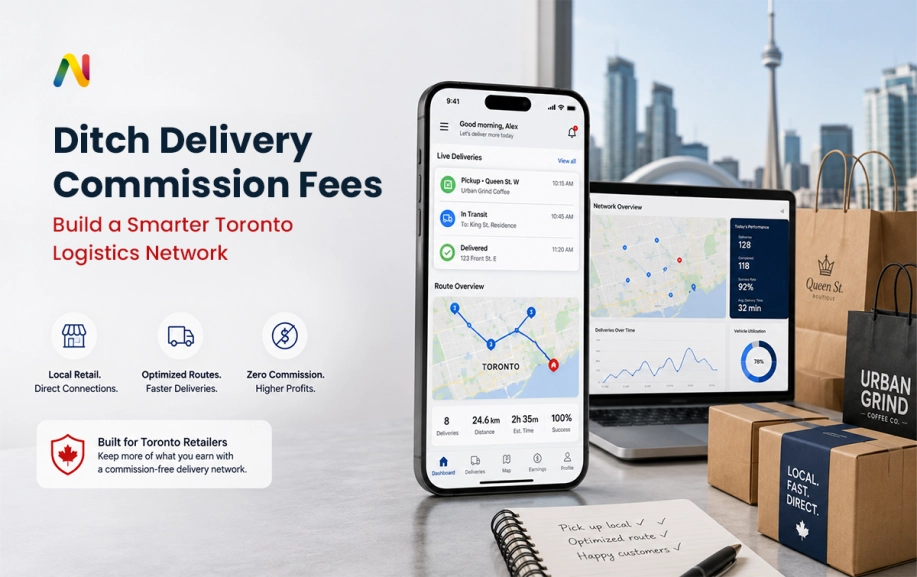
Retail businesses situated across the Greater Toronto Area (GTA) are now reaching a turning point. Right from the small local shops to large distribution centers, many are finding that relying on third-party delivery platforms is becoming too expensive. What were once promoted as helpful business tools have turned into costly middlemen, taking a significant share of every sale.
When any independent business loses around 15% to 30% of its gross order value to a tech platform, then the long-term survival becomes a numbers game it cannot win. This level of financial pressure has sparked a major shift toward independent technical infrastructure. Local merchants are actively exploring how the businesses can reduce delivery commissions. The answer is quite clear, which is by owning the code.
By building proprietary, decentralized delivery systems, local networks are reclaiming their revenue, controlling their customer data, and lowering transaction costs. Transitioning to this model requires deep engineering expertise. Forward-thinking merchant groups are investing in specialized on-demand logistics app development services in Toronto to transform high-overhead logistics into a lean, in-house profit center.
Why Toronto Retailers Are Moving Toward Commission-Free Delivery Models
Running a retail business in Toronto is already challenging, with high rents, tight profit margins, and strong competition. Adding the fees charged by third-party delivery apps can also make it harder for the businesses to remain profitable.
Business owners routinely seek answers to one big question, which is what are the benefits of a commission-free delivery model? The immediate answer here is none other than margin preservation. By eliminating the middleman, a retailer retains the entire gross value of the transaction, turning delivery from a loss-leader into a sustainable channel.
Beyond cost savings, owning your delivery system gives you full control over customer data, helping you build stronger relationships and run targeted marketing campaigns.
Furthermore, by relying on the external aggregators creates massive operational friction. Retailers cannot control the behaviour, presentation, or arrival times of the independent gig couriers. Owning the delivery process helps businesses maintain service quality and provide a better customer experience. This shift underpins the growing demand for dedicated Logistics App Development Toronto projects designed to handle regional fulfillment challenges.
What Is an On-Demand Logistics App?
To build an independent ecosystem, you must understand how these software architectures operate. An on-demand logistics system is an automated, multi-tiered software framework that connects an order management engine, a live driver dispatcher, and a customer interface into one unified cloud hub. Instead of relying on a human dispatcher to manually track text messages and route drivers, the application uses smart routing logic to automatically manage orders.
For corporations exploring On-Demand Delivery App Development, this software operates as the operational brain of the business. The system automatically receives orders from online stores, calculates shipment size, checks driver availability, and assigns the best delivery route in seconds. This helps reduce delays, manual work, and human errors.
Also, when building these systems, companies frequently seek answers to how does a commission-free delivery platform works. Unlike the public marketplaces that charge a percentage fee per order, an independent platform runs on your own secure servers. The business pays a fixed, predictable cost for software maintenance and cloud infrastructure. Whether your network fulfills 50 or 5,000 orders a day, the platform costs remain flat. This flat-rate framework allows companies to scale up volume without paying a growing tax to a tech intermediary.
Key Features of a Commission-Free Delivery Platform
At the time of exploring custom options or reviewing a white-label delivery app, organizations need to focus on technical capabilities rather than flashy layouts. If an app lacks a robust backend, it will crash during peak seasonal shopping periods.
Every effective Retail Delivery App Solution's architecture must include four foundational modules:
Dynamic Route Batching
To keep an independent local network profitable, you cannot have drivers making single drops across town. The app must feature smart batching algorithms that group multiple deliveries heading to the same area-like Liberty Village or the Annex into a single run. This reduces travel times and dramatically lowers the average cost per delivery.
Low-Latency Driver Telemetry
Real-time tracking surely needs regular coordinates from your drivers. In place of using heavy, battery-draining HTTP polling, a professional Hyperlocal Delivery App relies massively on lightweight WebSocket protocols or MQTT connections. The facility keeps location tracking smooth and accurate, even in times when couriers enter parking garages or highly dense downtown condo towers.
Smart Geo-Fencing and Zone Management
Toronto traffic is famous for wildly varying by neighbourhood and time of day. The backend must allow the managers to draw custom geographic boundaries directly on a map. This feature also allows the system to adjust delivery fees, estimate arrival times, and allocate specific driver types automatically based on regional conditions.
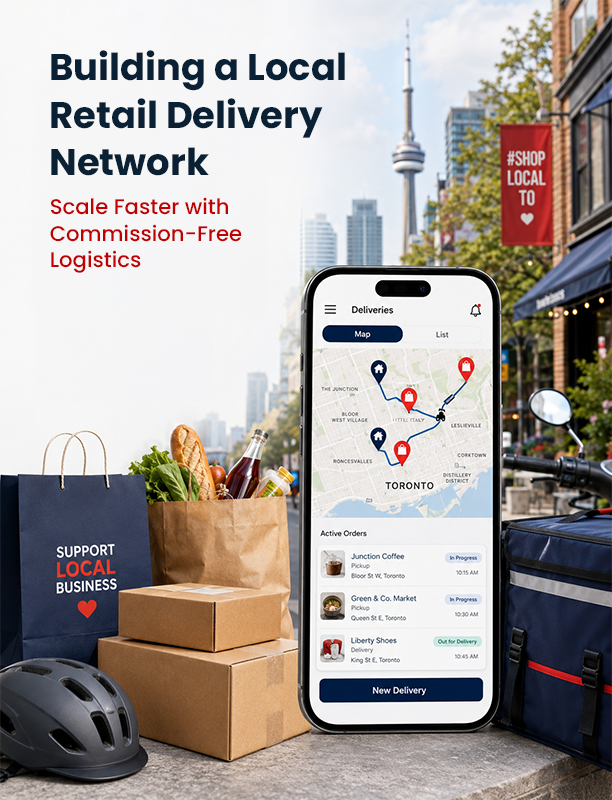
Building a Local Retail Delivery Network in Toronto
Running an independent fulfillment network in the GTA requires a clear understanding of the different delivery needs in a region. While suburban areas such as Scarborough and Etobicoke rely massively on vehicle-based deliveries, busy downtown locations often need a different approach to ensure faster and more efficient dispatch.
When considering how to set up these local pipelines, businesses often ask the question that can retailers build their own delivery network? Indeed, they can if they build it collaboratively. Merchant associations and local business improvement areas (BIAs) are pooling their resources to create shared driver pools. By sharing a dedicated fleet across multiple storefronts, a group can keep drivers busy all day, making the network highly cost-effective. The approach relies on the localized Toronto Delivery App Development strategies. The app should assign orders fairly, track driver payments accurately, and keep each store’s billing separate. This allows multiple businesses to share the same delivery network without confusion.
Last-Mile Delivery Technology Explained.
The final step in fulfillment is moving an item from a local shop's shelf to the customer's door, is the most complex and expensive part of logistics. For managers researching systems, a common entry question is: What is last-mile delivery software? At its core, it is the technology that manages the final leg of a package's journey. It handles scheduling, live tracking, automated updates, and verification tools to ensure a successful delivery.
Investing solely in dedicated last-mile delivery app development allows an enterprise to fully replace messy manual workflows with precise, and automated tracking. Instead of calling all the drivers to check their status, managers can now view a central live dashboard showing every active drop across the city.
One very important part of this technology is the proof-of-delivery module. To prevent customer disputes and delivery fraud, the mobile interface must require drivers to collect a digital signature, scan a secure barcode, or upload a photo of the package at the door. These verification points are tagged with instant GPS timestamps and synced to the cloud, providing the business with ironclad documentation for every completed order.
Cost of Logistics App Development in Toronto
Deploying an independent logistics platform is considered to be a major capital investment that requires careful financial planning. When corporate leadership teams begin budgeting, the initial question is always practical: What is the cost of building a logistics app in Toronto?
The concluding investment is well-determined by the complexity of your workflow, core integration requirements, and the chosen platform architecture.
To offer a realistic overview of the local tech space, here is a breakdown of the typical development costs and timelines across different engineering tiers:
While estimating the cost to develop a logistics app, organizations must look past the initial build price and account for long-term operational costs. A healthy budget should allocate resources for ongoing Website Maintenance Services, cloud hosting, and continuous database security patches to keep the platform fast and secure as traffic grows.
Joining hands with an established and reputed logistics software development company ensures that your capital is efficiently used. Experienced developers avoid building everything from scratch; they use proven open-source routing tools and secure frameworks to reduce development time while ensuring the final system can handle heavy real-world usage.
Multi-Vendor Delivery Architecture for Local Businesses
For neighbourhood shopping districts and retail groups to successfully challenge giant online marketplaces, they need a platform that supports multiple storefronts simultaneously. This brings up an important design question:
How do multi-vendor delivery platforms work?
A multi-vendor architecture runs a single, unified database that divides data into secure accounts for every store. Every participating business gets full access to a private dashboard for managing its own products, tracking incoming orders, and reviewing the custom data. Meanwhile, a central system also aggregates these orders, and enables a shared driver fleet to handle pickups from multiple locations efficiently.
Designing the multi-store network requires specialized custom logistics app development workflows. The underlying code must handle complex routing rules, split transaction payments accurately between stores, and manage inventory levels in real time across different point-of-sale systems.
With correct engineering, the system is functioning as the best delivery app for local retailers who are looking to scale up. It gives independent businesses the same advanced logistics capabilities as major global marketplaces, while keeping ownership, margins, and customer data in local hands.
How Netclues Develops Custom Logistics Apps for Retail Networks
Building a high-volume, resilient delivery infrastructure requires an engineering team that balances technical expertise with real-world business awareness. In Canada's competitive tech landscape, companies need a partner who understands how software engineering choices impact daily bottom-line operations.
Netclues provides premium, custom Mobile App Development Services for organizations that cannot afford system downtime or broken workflows. We do not build generic, surface-level templates. We design and build robust Enterprise Logistics Solutions tailored directly to your operational needs and local market realities.
Our expert engineering team specializes in commission-free delivery app development, creating quick, secure, and highly scalable code structures while eliminating the expensive middleman fees. From the deep point-of-sale integrations to super-advanced real-time driver-tracking tools, we offer the technical foundation your business needs for protecting its profit margins, controlling the customer data, and scaling local delivery operations smoothly.
Frequently Asked Questions
Q. 1. What features should a delivery app include?
A strong platform is expected to offer real-time tracking, route optimization, delivery notifications, and well-secure proof of delivery. Additionally, it must comprise POS integrations and an analytics dashboard to monitor the orders and the fleet performance.
Q. 2. How long does it take to develop a logistics app?
A custom solution can take nearly 4 to 9 months for developing, and launching. The time taken varies depending on the required integrations, routing features, and overall system complexity.
Q. 3. How can local retailers stay competitive to large delivery marketplaces?
Independently operating businesses can remain competitive by sharing delivering resources through commission-free networks. This allows local stores to offer fast, affordable delivery while keeping more of their profits and maintaining direct customer relationships.
Q. 4. Why should a business choose a custom build over a white-label app?
While white-label systems are known to offer a quick launch, these often alter the ongoing transaction fees and lack deep integration flexibility. Custom engineering gives the business 100% ownership of the source code, zero per-order platform fees, and also the ability to tailor the system directly to your existing software stack.
Q. 5. How do automated routing engines lower local delivery costs?
Automated routing software accurately analyze the driver locations and active drop-off points for building optimized, multi-stop routes. By ensuring that the couriers spend less time idling in traffic and travel the shortest possible distances, the system dramatically reduces the fuel usage and cuts average fulfillment costs.
Strategic Steps for Transitioning to an Independent Logistics Infrastructure
Moving away from established third-party delivery marketplaces is a big operational shift that requires a step-by-step approach. Cutting off your existing sales channels overnight can hurt your revenue. Instead, smart retail networks run a phased transition to protect their daily cash flow while building out their own system.
The beginning of the process is done by mapping out your current delivery volumes and identifying the most common drop-off zones. Use this real-world data to guide your initial How to build a delivery app research phase, ensuring your developers focus on the features your team needs most.
Once the core code is built, then proceed to launch a pilot program in a single neighbourhood. It helps to test the tracking systems and even train your core driver fleet. Connect your internal point-of-sale APIs during this trial period to ensure the order data flows smoothly without manual entry errors.
After getting verification that your platform handles real-world conditions well, proceed with migrating your repeat customers to your custom app through targeted local marketing campaigns and exclusive loyalty rewards. Following a step-by-step strategy allows you to steadily shifting the highest-margin volume away from expensive marketplaces, lowering your customer acquisition costs and building a sustainable, profitable delivery infrastructure for the long term.
Still struggling with high third-party commissions or trying to manage a messy delivery setup that eats into your retail margins? Our experienced engineering team at Netclues can analyze your current workflows, eliminate operational bottlenecks, and build a high-performance, custom platform tailored to your growth goals.
Connect with our logistics development team today to start planning your independent delivery infrastructure.
Key Takeaways
- Toronto retailers can use custom logistics technology to reduce dependence on third-party delivery marketplaces.
- Commission-free delivery does not mean zero delivery costs; it means greater control over the technology, economics, and customer relationship.
- A scalable logistics platform requires order management, dispatch, routing, tracking, merchant tools, driver applications, and administration.
- Multi-vendor architecture allows multiple retailers to share delivery infrastructure while keeping business data appropriately separated.
- Last-mile technology improves routing, scheduling, tracking, delivery visibility, and proof of delivery.
- Development costs depend on integrations, functionality, architecture, security, and scalability requirements.
- A phased Toronto pilot can help retailers validate their delivery model before expanding across the GTA.
Ready to build a commission-free delivery network for your retail business?
Netclues can help design and develop custom logistics software around your delivery workflows, merchant requirements, driver operations, integrations, and growth plans.
Talk to the Netclues logistics development team to map your requirements, estimate development scope, and determine the right architecture for your delivery network.