



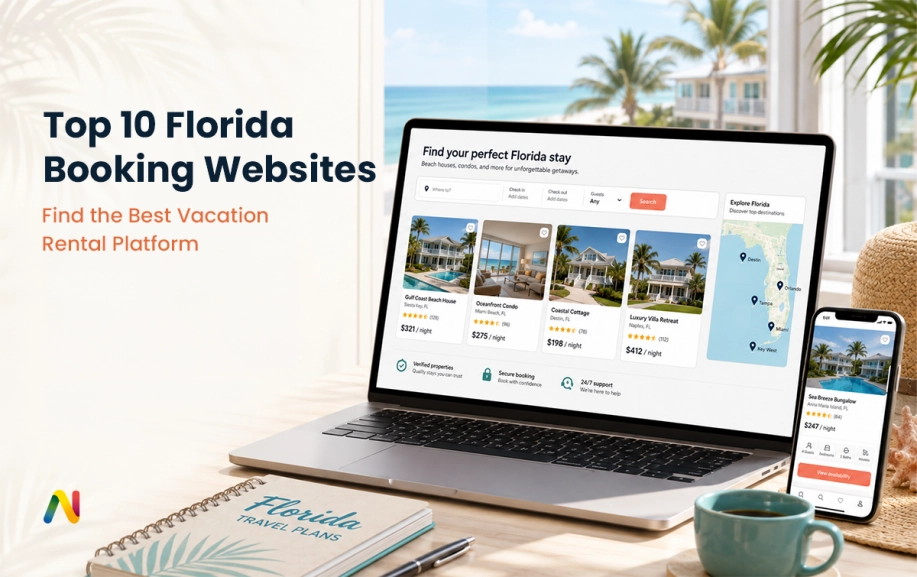
Whether you are a traveler planning a beachfront getaway in Miami or a property manager listing luxury villas in Orlando, the Sunshine State offers one of the most active hospitality markets in the world. Tourism here does not have a true off-season. Instead, it moves in waves, pulling in international families, out-of-state winter residents, and local professionals looking for quick weekend escapes.
Driven by high demand, a multi-billion-dollar network of digital platforms now connects travelers with suitable properties. So, the sites offer guests an easy way to identify suitable lodging solutions, while helping owners secure visibility and quickly fill open dates.
However, fully relying on third-party aggregators can at times end up with a serious business challenge. While these top ten websites deliver vital visibility, they also build a barrier between the provider and the guests. As a premier Florida web design agency, Netclues is helping hospitality brands shift from paying high third-party fees to owning their booking channels outright.
For better understanding, here is a detailed breakdown of the leading platforms driving bookings across the state today.
Navigating Florida's Vacation Rental & Staycation Market
The Florida Booking Landscape
The local market is widely segregated into three groups global giants, regional sites, and luxury networks. Big OTAs make use of massive budgets to capture the broad searches like "Florida beach houses." Regional platforms focus on building local trust, while luxury networks cater to high-end travelers looking for fully managed stays.
The Cost of Third-Party Platforms
A key downside of relying on these major platforms is the high financial cost. Most of the third-party listing networks charge property managers and guests a combined OTA commission fee in Florida` that ranges from 15% to 25% on every transaction. Beyond the lost revenue, these platforms hide guest email addresses and phone numbers. This structural barrier stops you from building a customer database, keeping you dependent on their ecosystem for repeat business.
The Tech Solution (Direct Bookings)
To protect your profit margins and build long-term business value, successful operators treat third-party websites as discovery tools rather than permanent homes for their clients. They capture the initial booking through an OTA, deliver an incredible on-property experience, and then guide that guest to book directly for their next visit.
Transitioning successfully to this model indeed requires moving away from basic, generic templates. True independence requires partnering with an experienced vacation rental website development company. An expert team can actually build a dedicated, high-performing platform around a custom booking engine development project. It acts as a promise that the site will easily handle complex rates, rules, and live scheduling without strongly relying on restrictive third-party software.
The Global Giants that are literally dominating the markets in Florida are listed here:
1. Airbnb & VRBO: The heavyweights of Panhandle and Keys rentals
Airbnb and VRBO are the undisputed market leaders across the entire state, but they attract slightly different audiences. Airbnb thrives on urban apartments in downtown Miami, unique staycation spots, and short-term bookings. VRBO focuses entirely on whole-home rentals, making it a dominant force for large family reunions along the Destin Panhandle and traditional weekly beach stays throughout the Florida Keys. It offers great initial exposure to the property managers. One downside is that these often enforce strict cancellation rules and take a significant cut of your top-line revenue through host fees and guest service charges.
2. Booking.com: Capturing the international European tourist
Booking.com is a global powerhouse that brings an immense volume of international inbound travelers to major hubs like Orlando, Miami, and Fort Lauderdale. European and South American tourists are highly familiar with this platform and frequently use it to book long, multi-week summer holidays. One big challenge is in the hotel-first architecture. It forces vacation rentals into rigid booking frameworks that do not always match the realities of managing standalone homes.
Florida-Specific and Niche Staycation Platforms
3. FloridaRentals & Emerald Kite: Regional specialization
Regional sites like the FloridaRentals and Emerald Kite, capture the highly targeted as well as intentional traffic. Users get to visit these platforms while hunting for Sunshine State properties, often bypassing the clutter of global search engines. FloridaRentals is known for using a subscription-based listing model rather than a per-booking commission fee, making it a popular choice for independent owners.
Emerald Kite is working with a deep focus on concierge-style matchmaking for vacationers. These Florida vacation rental booking websites majorly target loyal, returning travelers who prefer regional expertise over generic corporate aggregators. They are excellent additions to a balanced distribution plan.
4. Plum Guide & Elite Destination Homes: The luxury UHNW market
Plum Guide and Elite Destination Homes cater strictly to ultra-high-net-worth (UHNW) travelers looking for vetted, top-tier accommodations. Plum Guide applies a rigorous multi-point inspection process to every listing, accepting only a small percentage of homes in premium markets like Palm Beach or the Miami elite districts. The platform of Elite Destination Homes focuses on high-end asset management and curated group travel. Hence, if you want to represent premium architecture, high-end amenities, and custom concierge services, then these specific Florida staycation platforms will work best.
5. Rentyl Resorts, Vacasa, & Marriott Homes & Villas
This final group represents the institutional, brand-backed side of the market. Rentyl Resorts blends the space of a private villa with the consistent amenities of a traditional resort hotel, which is highly popular in the competitive Orlando attractions market. Vacasa acts as a massive corporate property manager that also runs its own consumer-facing distribution platform.
Marriott Homes & Villas allows premium property managers to list homes within the Marriott Bonvoy loyalty ecosystem. This grants access to millions of business and leisure travelers looking to redeem corporate loyalty points for residential vacation stays.
The Hidden Trap of the Top 10: OTA Commission Fatigue
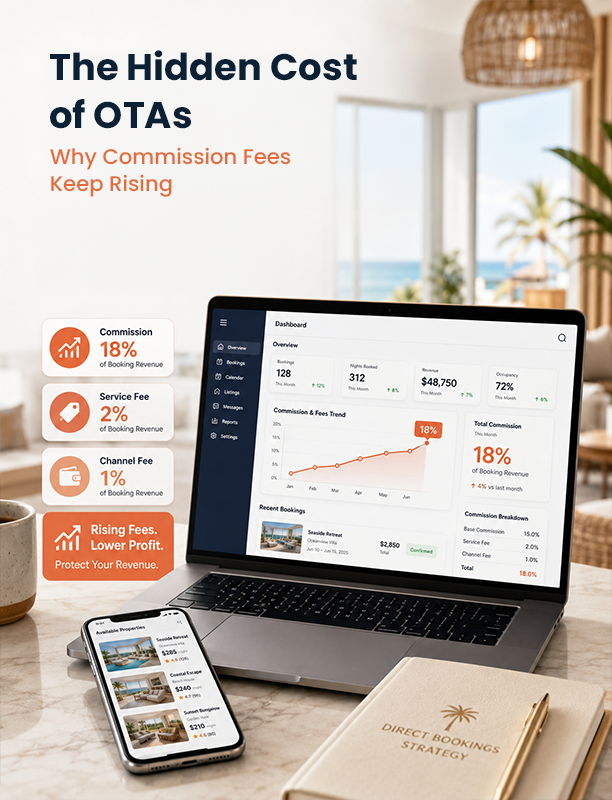
Why losing 20% of your revenue to third-party platforms halts your growth
When you analyze your annual finances, losing 15% to 25% of your gross revenue to booking platforms changes your entire business trajectory. That capital should be buying new property assets, funding local maintenance staff, or increasing your local marketing reach.
Instead, it pays for the OTA's global advertising campaigns. For scaling hospitality businesses, this constant drain makes it difficult to maintain healthy cash flow and slows down your ability to scale your portfolio.
The loss of guest data and remarketing control
The hidden cost of relying entirely on major travel sites is the total loss of guest data. When a guest books through a major corporate platform, they are technically that platform's customer, not yours.
The system masks their real email address with an encrypted, temporary alias that expires shortly after check-out. This stops you from sending seasonal promotions, offering special loyalty rates, or running targeted winter campaigns. You are forced to pay a commission fee to acquire the exact same guest year after year.
Why do you need a vacation rental website development company?
Building a real hospitality brand is not an easy job. It actually requires much more than launching a basic, static website with an unverified availability calendar. Savvy travelers look for professional, secure interfaces that match the polished design of major hotel chains.
Professional support lets you build a site that is fine-tuned to match your business. It easily handles local taxes, seasonal rates, and interactive maps, and hence, acts as a trust builder for visitors.
Seamless PMS integration (Guesty, Hostaway) and Channel Managers
A standalone website turns valuable when it connects directly with your daily operational software. Professional agencies help to build your platform using advanced PMS API integration (Guesty, Escapia) protocols. The deep technical link further promises that each episode, when a guest views a listing on the site, they will see live pricing and actual availability that is pulled directly from the central operational dashboard. By utilizing automated channel manager software syncing, updates to your rates, house rules, or blocked dates push instantly to all active channels simultaneously, keeping your entire operation perfectly aligned.
Engineering a Flawless Custom Booking Experience
Avoiding double-bookings with real-time API calendar syncing
One huge concern that most property managers encounter while expanding beyond standard booking platforms is the logistical risk of double-bookings. If a guest reserves a luxury home on your direct site at 9:00 AM, that exact timeframe must lock out on Airbnb and VRBO immediately.
Cheap iCal feeds usually come across sync delays that can last anywhere from fifteen minutes to several hours. By working with professional property management software developers, you can implement live, two-way API webhooks. These connections transmit booking data across all channels in milliseconds, protecting your brand reputation and keeping your calendars clean.
Why must you hire hospitality web developers for secure payment gateways?
Processing high-value vacation transactions requires a secure, specialized technical architecture. This is not the place to use generic, plug-and-play e-commerce widgets. You need to hire hospitality web developers who understand the unique financial requirements of the travel industry.
The payment infrastructure has to accurately process multi-tiered deposits, collect split payments, hold automated security wraps, and handle regional lodging taxes across different Florida counties. Building a secure checkout flow protected by modern encryption standards ensures safe transactions for your guests and protects your business from costly chargeback disputes.
Technical Architecture of an Enterprise Direct Booking Platform
To help your team map out your technology stack, it helps to understand how these systems interact. A premium direct platform does not function as a single, isolated website. Instead, it operates as an interconnected ecosystem where data flows smoothly between the front-end design and your back-end management tools.
When building this ecosystem, choosing to create custom vacation rental software allows you to tailor your business logic to your specific workflow. Instead of changing your internal processes to fit within the limitations of generic template software, your technology adapts to support how you actually manage your portfolio.
Comparing the Approaches: Custom Platforms vs. Templates
While picking a long-term digital strategy, the operators want to know the actual utility of custom engineering compared to standard templates.
Here is a comparison chart highlighting why leading property groups choose dedicated engineering paths to support their portfolios.
Strategic Blueprint: Building a Direct Channel
If you want to move away from third-party platforms and build your own independent channel, you need to plan carefully. The extensive planning task is no less than a complex engineering job that needs a clear, step-by-step roadmap to execute successfully.
Phase 1: Mapping Operations and Technical Specs
Before writing the code, the development team must review your current operational setup. This means analyzing how you manage guest records, tracking your seasonal rates, and identifying every local county tax requirement. At this stage, engineers map out how your custom vacation rental software will connect with your existing Property Management System.
Phase 2: User Experience and Interface Design
The front-end design has to be neat and intuitive for converting visitors into loyal guests. High-end rentals require large, fast-loading image galleries, clear amenities lists, and an ultra-smooth checkout process. Also, the whole interface must be fully optimized for mobile devices too.
Phase 3: API Integration and Live Syncing
The integration phase is called the core engineering phase. In this case, the developers focus on integrating a booking engine with Guesty PMS or any preferred core management software. They aim to build the data bridges that handle live pricing, sync availability calendars, and push reservation details back to your main database instantly.
Phase 4: Security Reviews and Launch Testing
Before making the site open to live traffic, it is essential for the team to run deep security and performance testing. Here, tests are conducted on varied aspects, such as payment processing security, to verify that the calendar syncs happen in real time, and checking that the site performs perfectly under high user traffic. Once all tests pass, your direct booking platform is ready to go live.
Understanding the Financial Investment in 2026
When planning your budget to move away from third-party sites, you need to understand the actual market landscape. A common question for growing businesses is: What is the actual cost to build a direct booking website in 2026?
The cost of investment largely depends on the approximate size of your property portfolio and also the complexity of the operational workflow:
- Boutique Portfolios (1 to 10 Properties): For smaller operators, using the standardized PMS connections, a professional custom-designed platform typically ranges from $8,000 to $15,000. This covers responsive front-end design, basic API setups, and secure payment processing.
- Mid-Market Portfolios (11 to 50 Properties): As the portfolio widens, managing all complex operations becomes more demanding. A dedicated platform tailored for mid-market groups generally ranges from $18,000 to $35,000. This level of investment includes advanced filtering options, custom corporate accounts, and automated marketing tools.
- Enterprise Property Networks (50+ Properties): Large enterprise management networks require highly robust, scalable software architectures. These enterprise-grade systems start at $45,000 and up. They feature multi-layered PMS connections, automated multi-county tax processing, custom guest portals, and dedicated data analytics dashboards.
It is a relief to know that, though the development costs need an upfront investment, handsome returns are assured. By eliminating 15% to 25% commission fees on repeat guests, a custom platform often pays for itself within its first year of operation.
The Operational Playbook for Direct Guest Conversion
Launching your new website is only the first step. To make your direct booking strategy work, you need to actively guide guests away from major third-party platforms and into your owned channel.
Step 1: Maximize On-Property Branding
It is important to ensure that the vacation rentals you pick do not reveal your real identity. Hence, it is recommended by the experts to use custom elements such as the welcome mats, high-quality digital guest books, and branded kitchen amenities that showcase your property management brand. When guests look around the home, they should see your company's name, not the logo of a third-party booking site.
Step 2: Use Smart Digital Signage
Signage plays a huge role in attracting the right audience. Place a sleek, framed QR code in the kitchen or the main entryway. Pay attention to labeling. Also, check that, as the guests scan the code, you should direct them to a customized welcome page on your website. The scenario works best to give your guests an instant value while naturally introducing them directly to your brand ecosystem.
Step 3: Run Smart In-Stay Marketing Campaigns
Building loyalty is an art, and you have many ways to practice the same. For instance, once you've captured a guest's direct contact info through your welcome portal, you can very well use that information for building long-term loyalty. Send a friendly text or email midway through their stay: "We hope you are loving your Miami vacation! Enjoy 10% off your next staycation when you book directly on our site." Offering this value while they are actively enjoying their trip is a highly effective way to secure future direct business.
Alternatives to Airbnb for Florida Property Managers
For the operators willing to expand their distribution, it is a smart move to explore professional alternatives to Airbnb for Florida property managers. While Airbnb controls a massive share of the market, relying on a single channel leaves your business vulnerable to sudden algorithm shifts or unexpected policy changes. Also, distributing listings across specialized networks like Plum Guide, Marriott Homes & Villas, or your own direct booking platform helps reduce business risk. This multi-channel approach protects your revenue stream while offering access to a huge variety of high-paying guest demographics.
How to Build a Vacation Rental Website like VRBO?
For large property groups and scaling hospitality brands, the ultimate goal is often learning how to build a vacation rental website like VRBO. Achieving this requires moving beyond basic content management systems and investing in a true multi-vendor software architecture.
A credible database is a must for efficient handling of complex geolocation searches, advanced property filtering, and distinct user dashboards, both for the property owners and the guests. It is not possible to design a high-performance system without having a deep understanding of the cloud infrastructure, advanced database optimization, and scalable API design. This ensures that your platform handles thousands of simultaneous users without any lag.
FAQs
Q. 1. How long does it take to build a custom direct booking platform?
A standard custom platform integration typically takes between 8 and 14 weeks to design, develop, and thoroughly test. Complex enterprise systems featuring multi-vendor functionality or custom operational logic can take 4 to 6 months to fully deploy.
Q. 2. Can I still use Airbnb and VRBO if I launch my own direct booking website?
Absolutely. A strong direct booking strategy does not mean completely abandoning major online travel agencies. Instead, you use those major platforms as discovery engines to attract first-time guests, while using your direct site to retain those guests for all future stays.
Q. 3. How does a non-functioning property's management software affect my bookings?
By utilizing professional API integrations, your website communicates securely with your Property Management System using smart caching protocols. If your core PMS experiences a temporary outage, your website can store user requests safely and sync them the moment connections are restored, ultimately preventing data loss.
Q. 4. Do I need to be a technical expert to manage a custom vacation rental website?
Not at all. Professional web development firms build clean, intuitive administrative dashboards on the backend. The system further allows your team to easily update text, swap out photos, and manage blog posts without ever needing to touch a line of code.
Q. 5. How do direct booking websites take care of guest verification and security?
The custom platform can integrate directly with automated guest screening services such as Superhog or Know Your Guest through secure APIs. The smart systems automatically verify guest IDs, even run a background check, and manage security deposits. All these massively help in keeping the properties protected.
Q. 6. Will a custom direct booking platform help my business rank better on Google?
Yes. Unlike generic template sites or restrictive OTA profiles, a custom website is built from the ground up with clean code and fast loading speeds. This optimized structure makes it much easier to execute a targeted local SEO strategy, helping your brand rank higher for valuable local search terms.
Don't Rent Your Guests, Start Owning Them!
Relying fully on third-party travel sites is a sign that you are renting your customers from global tech corporations. So, whenever these platforms shift their search algorithms or raise their fee structures, your hospitality business can face an uninvited risk. True operational freedom comes from building and owning your own digital distribution channel.
By investing in a secure, custom-engineered platform that connects directly with your property management software, you protect your hard-earned profit margins, take full control of your guest data, and build lasting equity in your local brand.
To break free from high platform fees and build your own high-performing direct booking platform, visit Netclues today.