


Owning a digital product is a common dream for most entrepreneurs in the year 2026. However, the path from a great idea to a profitable platform is paved with technical choices and financial decisions. Understanding the custom SaaS development cost is the first step for any founder. The market has changed; we are no longer just building simple websites. We are building complex, cloud-based systems.
If you are looking for a SaaS application development company, you need to know exactly where your money goes. This guide breaks down the real-world expenses of building and launching a platform in today's fast-moving tech world.
How much does it cost to build a SaaS MVP?
When you start, the goal is to build a SaaS MVP. An MVP is also known as a Minimum Viable Product, and it is the simplest version of your idea that still solves a problem for users. It is a way to test the market without spending millions. In 2026, the SaaS MVP budget is influenced by the number of "ready-to-use" tools you can integrate.
A basic MVP usually includes a way for users to sign up, a core feature that does the work, and a way to pay. Even for a simple version, you should plan to hire SaaS developers who understand how to keep the code clean so it can grow later. Starting too cheaply often leads to "technical debt," which costs much more to fix down the road.
Serverless architecture cost for SaaS
One of the best ways to manage your Cloud infrastructure pricing is to go serverless. In the past, you had to pay for a server even if nobody was using your app. Today, cloud-native software development allows you to pay only when someone actually clicks a button.
This lowers your monthly bills early on. However, as you grow, serverless costs can spike if your code is not efficient. This is why you need to hire dedicated full-stack developers who can write optimized code. They ensure that your cloud-native software development strategy stays affordable as your user base grows from 10 people to 10,000.
Hidden costs of running a SaaS business
The build cost is just the beginning. Many founders forget about the ongoing "digital rent" required to stay online. SaaS security standards (SOC2 compliance) are a huge part of this. In 2026, users and big companies will not trust you if you do not have these badges. Getting compliant can cost thousands in audits and security tools.
Then there is SaaS API development. If your app needs to talk to Slack, Gmail, or a custom database, you have to build and maintain those connections. There are also SaaS security standards (SOC 2 compliance) audits conducted annually. You also need to budget for Churn reduction features. These are tools like automated emails or feedback loops that stop people from cancelling their subscriptions.
React vs Vue for SaaS dashboards
Choosing the right "frontend" is vital for your user experience. Most SaaS application development company experts will suggest either React or Vue. React is great if you want to hire dedicated full-stack developers easily because it is so popular. It is powerful and can handle very complex, data-heavy dashboards.
Vue is often seen as a lighter and faster option. It is great for getting an MVP to market quickly. Both choices enable a smooth Single Sign-On (SSO) implementation, allowing users to log in with their Google or Microsoft accounts. This small feature is huge for user growth because it removes the "new password" headache.
Timeline to launch a custom SaaS product
Building a high-quality platform takes time. A standard Build a SaaS MVP project usually takes three to five months. A more complex mid-market product might take six to nine months. The timeline is often determined by how complex your SaaS API development needs are and how many third-party tools you are connecting.
To stay on schedule, you must have a clear roadmap. Delays usually happen when the "scope" changes in the middle of the build. By having a SaaS application development company manage the project, you ensure milestones are met, and the SaaS MVP budget is not blown out of proportion by unnecessary features.
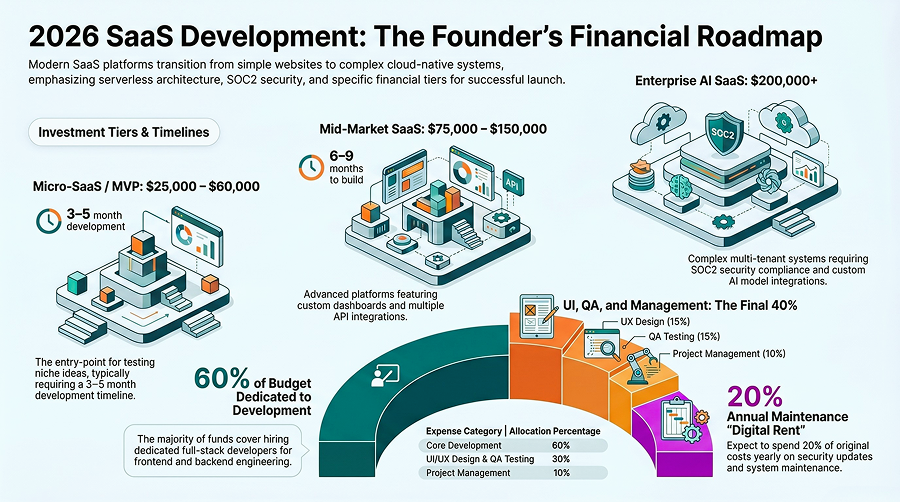
2026 SaaS Development Price Estimates
The price to build depends on what you are trying to achieve. Here is how the market looks in 2026.
Budget Estimates by Complexity
- Micro-SaaS / MVP: $25,000 – $60,000. This covers core features and one platform. It is perfect for testing a niche idea.
- Mid-Market SaaS: $75,000 – $150,000. This includes a custom dashboard design, multiple SaaS API development points, and better scale.
- Enterprise AI SaaS: $200,000+. This is for a multi-tenant system that requires SaaS security standards (SOC 2 compliance) and may include a custom AI model integration.
Where Does Your Budget Goes?
- Development (Backend/Frontend): 60%. This is where you hire SaaS developers to build the engine of your business.
- UI/UX Design: 15%. This is vital. Good design is one of your best Churn reduction features.
- QA & Testing: 15%. This covers SaaS security standards (SOC2 compliance) checks and making sure there are no bugs.
- Project Management: 10%. This keeps the team moving and the project on time.
Hidden SaaS Costs
- API Fees: You may need to pay for OpenAI tokens, Twilio SMS alerts, or Subscription billing integration (Stripe/Paddle).
- Maintenance: You should expect to spend about 20% of your original Custom SaaS development cost every year just to keep things updated and secure.
Tech Stack and Features
To succeed, your platform needs to be modern and easy to use. This means focusing on the "plumbing" of the app.
Subscription billing integration (Stripe/Paddle)
You cannot have a SaaS without a way to get paid. Subscription billing integration (Stripe/Paddle) is the standard. These tools handle taxes, different currencies, and recurring bills automatically. A good SaaS application development company will set this up so that you can offer free trials and coupons to attract new users without having to write code every time you want to change a price.
Single Sign-On (SSO) implementation
If you want to sell to big companies, you need a Single Sign-On (SSO) implementation. It allows their employees to use their work email to log in safely. This is a core part of SaaS security standards (SOC2 compliance) and makes your app look much more professional. It is a feature that often pays for itself by helping you close bigger deals.
Summary of the Guide
Building a SaaS in 2026 is an investment in a digital asset. While the Custom SaaS development cost might seem high at first, the ability to scale to thousands of users with very little extra cost is what makes this business model so great. By focusing on a strong SaaS MVP budget and choosing the right SaaS application development company, you can turn your vision into a reality.
It is very important to stay prepared for the "unseen" costs, such as SaaS security standards (e.g., SOC2 compliance) and ongoing maintenance. The most successful platforms are those that start with a solid foundation and grow based on what their users actually want.
At Netclues, we know that building a software business is a major journey. We are a dedicated SaaS application development company that focuses on helping founders turn ideas into scalable, secure products. Whether you need to hire SaaS developers for a quick MVP or want to hire dedicated full-stack developers for a complex enterprise build, we have the expertise to get you there. From Subscription billing integration (Stripe/Paddle) to high-level SaaS security standards (SOC2 compliance), we handle the technical heavy lifting so you can focus on growing your brand.
Resource & Vendor Planning Tools
To get an accurate forecast, consider exploring these resources for your planning:
- Explore custom project roadmaps and full-service scopes on Netclues.
- Evaluate budget ranges for complex integrations via the AI Development Cost Guide.
- Learn about cost-effective resource management on the Hiring Dedicated Development Team page.
- Read the Cost to Build Agentic AI to understand AI deployment estimates.
FAQs
Q.1. How much does custom SaaS development cost in 2026?
A. Custom SaaS development costs typically range from $25,000 for a basic MVP to more than $200,000 for enterprise-grade platforms. Pricing depends on features, integrations, security requirements, scalability goals, and development complexity.
Q. 2. What is included in a SaaS MVP?
A. A SaaS MVP usually includes user authentication, core functionality, payment processing, an admin dashboard, and basic analytics. The goal is to validate product-market fit before investing in advanced features.
Q. 3. Why do SaaS development costs vary so much?
A. Costs vary based on project scope, technology stack, UI/UX complexity, API integrations, compliance requirements, cloud infrastructure, and the size and experience of the development team.
Q. 4. How long does it take to build a SaaS platform?
A. Most SaaS MVPs take three to five months to launch. More advanced platforms with custom workflows, integrations, AI capabilities, and enterprise security features can take six to twelve months or longer.
Q. 5. What are the biggest hidden costs in SaaS development?
A. Common hidden expenses include cloud hosting, API subscriptions, monitoring tools, security audits, compliance certifications, maintenance, customer support systems, and ongoing feature updates.
Q. 6. Is serverless architecture cheaper for SaaS applications?
A. Serverless architecture can reduce costs during the early stages because businesses only pay for actual usage. However, inefficient code or rapid growth can increase expenses, making optimization important.
Q. 7. What is the ROI of building a custom SaaS platform?
A. A successful SaaS product can generate recurring subscription revenue, improve customer retention, and scale efficiently. ROI depends on user acquisition, retention rates, pricing strategy, and operational efficiency.
Q. 8. Should startups build a custom SaaS platform or use no-code tools?
A. No-code tools are useful for validating simple ideas quickly. Custom SaaS development becomes a better option when businesses need scalability, advanced functionality, security controls, or proprietary features.
Q. 9. How important is SOC 2 compliance for SaaS companies?
A. SOC 2 compliance helps demonstrate strong security practices and builds trust with customers. It is often required when selling SaaS solutions to larger organizations and enterprise clients.
Q. 10. What integrations are commonly required in SaaS products?
A. Popular integrations include payment gateways, CRM systems, analytics platforms, communication tools, cloud storage, authentication providers, AI services, and customer support software.
Q. 11. Which frontend framework is better for SaaS dashboards: React or Vue?
A. React is widely adopted, highly scalable, and supported by a large developer community. Vue is often faster to implement and easier to learn. The right choice depends on project goals and team expertise.
Q. 12. How much should I budget for SaaS maintenance?
A. A common recommendation is to allocate approximately 15%–25% of the initial development investment annually. This covers updates, bug fixes, security patches, infrastructure management, and performance improvements.
Q. 13. Can AI reduce SaaS development costs?
A. AI tools can accelerate coding, testing, documentation, and workflow automation. While they improve efficiency, skilled developers are still needed to ensure quality, security, scalability, and business alignment.
Q. 14. What security features should every SaaS platform include?
A. Essential features include encryption, role-based access controls, secure authentication, SSO support, audit logging, automated backups, monitoring, and compliance-ready security practices.
Q. 15. What trends will influence SaaS development costs after 2026?
A. Key trends include AI-powered automation, multi-tenant architectures, low-code development, cloud optimization, enhanced cybersecurity requirements, data privacy regulations, and advanced user personalization.
Q. 16. Is spending $50,000 on a SaaS MVP worth it?
A. If the MVP validates a genuine market need and generates customer feedback, a $50,000 investment can significantly reduce long-term product risk and improve future funding opportunities.
Q. 17. Why do SaaS agencies quote such different prices?
A. Different agencies vary in expertise, development processes, team structures, quality standards, geographic location, and included services such as design, testing, security, and project management.
Q. 18. Can a solo founder realistically launch a SaaS business?
A. Yes. Many successful SaaS businesses started with solo founders. Success depends on market validation, execution, technical support, customer acquisition, and ongoing product improvements.
Q. 19. What usually causes SaaS projects to go over budget?
A. The most common reasons include changing requirements, unclear specifications, unexpected integrations, security challenges, poor planning, and underestimating maintenance and infrastructure costs.
Q. 20. Should startups prioritize features or speed to market?
A. Most startups benefit from launching quickly with essential features. Early customer feedback often provides more value than spending months building functionality users may never need.