


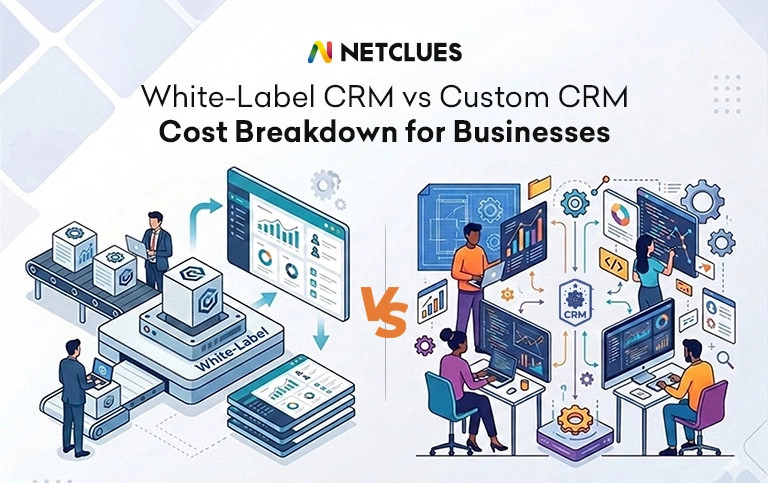
Making the selection of the right customer relationship management tool is a situation that every developing firm has to face. The debate usually centers on whether you should invest in Custom CRM software development or opt for a pre-built white-label solution. On the surface, a ready-made platform seems like the quickest and most affordable route. However, with the alternating business needs, the long-term financial impact now tells a different story. Deeply understanding the true cost of each alternative definitely requires looking past the initial price tag and examining how each choice affects your operations, security, and scalability.
Hidden costs of white-label CRM
White-label solutions are usually promoted as the cheaper and friendlier technique to get started. Here, you would pay a fee, slap your logo on the interface, and go live. But many organizations eventually suffer from SaaS subscription fatigue. This happens when monthly per-user fees continue to climb as your team expands. What initiated as a small monthly expense can suddenly turn into a massive annual drain on your valued resources.
Beyond just the base price, White-label CRM pricing rarely covers everything that you would practically need. Many of these platforms further charge extra for all the premium features, higher data storage limits, or for offering advanced automation tools. If you need a Custom dashboard design to see your specific KPIs, you might find that the platform is too rigid to allow it, or it requires an expensive upgrade. Furthermore, many businesses overlook the cost of Legacy system integration. Trying to force a generic white-label tool to talk to your existing accounting or inventory software often requires expensive third-party connectors that add even more to your monthly bill.
Custom CRM ROI calculation
When you look at Custom CRM software development, the return on investment is measured by efficiency and ownership. While the upfront cost is much higher, you are actually building a tool that closely fits your workflow perfectly. You are not paying for fifty features your team would never actually use. Instead, you are making a valid investment in a system where every single button and process serves a purpose.
To calculate the ROI, you must compare the lifetime value of the software against the endless cycle of subscriptions. With a custom solution, you avoid the per-user tax. Whether you have ten employees or a thousand, the software remains yours. A professional CRM software development company can help you automate specific tasks that a generic tool cannot handle, saving hundreds of man-hours every year. This boost in productivity, combined with the lack of recurring licensing fees, often leads to the system paying for itself within two to three years.
Cost to build a CRM like Salesforce
Many dignified leaders ask about the cost of Custom CRM development compared to giant platforms like Salesforce. Salesforce is indeed a massive ecosystem, but most businesses only use a fraction of its power. If you are someone wanting to build a streamlined version that focuses only on your specific sales funnel, the Custom CRM development cost is much more manageable than people think.
Building a sustainable, high-tier system involves several phases. First, you must hire CRM developers who truly understand database architecture as well as user experience. The total price will eventually depend on the complexity of the features, namely, AI-driven lead scoring or complex reporting modules. While a global giant such as Salesforce might cost a large firm millions in annual fees, a dedicated custom build provides the same core utility for a one-time investment that serves the business for a decade.
One-time cost vs monthly subscription CRM
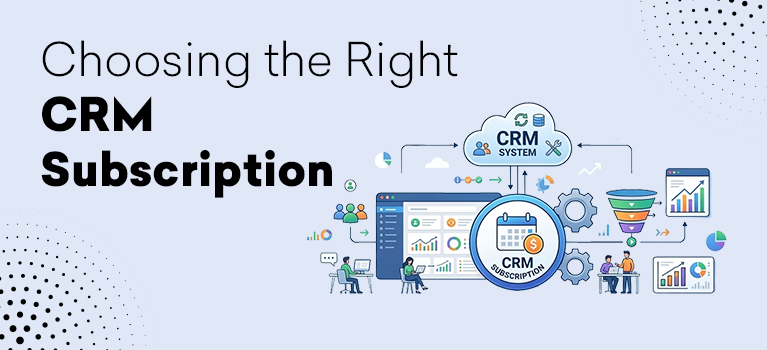
This is the classic build vs. buy CRM software dilemma. A monthly subscription is an operating expense that never ends. It is easy to start, but it offers no equity. You are essentially renting your business infrastructure. On the other hand, Custom CRM software development is a capital expenditure. You are creating a digital asset that adds value to your company.
The one-time cost model removes the fear of sudden price hikes from a software vendor. It also eliminates the risk of a vendor shutting down or changing their terms of service. When you own the code, you control the roadmap. You can decide when to update and what new features to add based on your actual budget and needs, rather than being forced into a new version you did not ask for.
Security of custom vs SaaS CRM
In an era of frequent data breaches, Data ownership & privacy have become top priorities. When you use a SaaS or white-label CRM, your sensitive client data lives on someone else's server. You are at the mercy of their security protocols. If their platform is targeted, your data is at risk. For many industries, this lack of direct control is a significant liability.
Custom CRM software development allows you to build a fortress around your data. You can choose exactly where the data is hosted and who has access to it. You can implement specific encryption standards and security layers that meet your internal compliance requirements. Owning the system means you have total Data ownership & privacy, ensuring that your customer list—the most valuable asset you have—is never shared or analyzed by a third-party vendor for their own gain.
Finalizing the choice for your business
Choosing between white-label and custom is ultimately about the stage of your business. If you are a tiny startup with no specific processes, a white-label tool might get you through the first year. But for any established business with a unique way of doing things, Custom CRM software development is almost always the more economical choice in the long run. It removes the friction of generic tools and stops the bleeding of monthly subscriptions.
By deciding to build, you are choosing a path of independence. You get a Custom dashboard design that shows exactly what you need to see. You ensure seamless Legacy system integration, so your whole office works as one unit. Most importantly, you create a tool that grows with you, rather than a tool that charges you more just for growing.
When you feel that you are well prepared to stop renting and start owning your business intelligence, it signals the perfect time to consult with experts who understand the nuances of the industry. A reliable CRM software development company can take your complex requirements and turn them into a streamlined, powerful tool that gives you a competitive edge.
Are you up for building a system that truly belongs to you? If yes, then look no further than Netclues. The team specializes in creating powerful, scalable solutions that are tailored to your unique business goals. Whether your requirement is to integrate complex data or to precisely design a brand new interface from scratch, the team will help you move away from expensive subscriptions and toward total digital ownership.
Take the first step toward a more efficient future and explore our expertise at https://www.netclues.com/ today.
FAQs
Q. 1. Is a custom CRM truly more cost-effective than a white-label solution?
A. Yes, for established businesses. While white-label CRMs have lower entry costs, they carry recurring per-user fees that grow with your team. A custom CRM is a one-time capital expenditure. Over a 3-to-5-year period, the lack of subscription fees and the boost in efficiency from tailored workflows usually result in a much lower Total Cost of Ownership (TCO).
Q. 2. What are the hidden costs associated with white-label CRMs?
A. Beyond the monthly fee, hidden costs include premium feature add-ons, increased data storage charges, and "connector fees" for third-party integrations. Additionally, the "rigidity tax"—the cost of changing your business processes to fit the software—can lead to significant productivity losses that don't exist with a custom-built solution.
Q. 3. How do I calculate the ROI of a custom CRM build?
A. ROI is calculated by comparing the upfront development cost against the lifetime value of the software. Factor in the elimination of monthly licensing fees across your entire headcount and the man-hours saved through bespoke automation. Most custom systems achieve a break-even point within 24 to 36 months, after which they provide "free" infrastructure.
Q. 4. Can I build a CRM with features similar to Salesforce?
A. Absolutely. Many businesses find that they only use 20% of Salesforce’s features despite paying for 100%. A custom CRM allows you to build a streamlined, high-performance version of that ecosystem, focusing specifically on your unique sales funnel and reporting needs for a one-time investment rather than a million-dollar annual contract.
Q. 5. How long does custom CRM software development typically take?
A. A standard custom CRM project involves phases like discovery, architecture design, development, and testing. Depending on complexity—such as AI-driven scoring or complex legacy integrations—the timeline usually ranges from 3 to 9 months. This investment results in a permanent digital asset that serves the business for a decade or more.
Q. 6. What is "SaaS subscription fatigue" in business software?
A. SaaS subscription fatigue occurs when a company's monthly operational expenses (OPEX) balloon due to dozens of per-user licenses. As teams grow, these small fees become a massive annual drain. Switching to a custom CRM turns this ongoing expense into a one-time capital investment (CAPEX), freeing up budget for other growth initiatives.
Q. 7. Is my data safer in a custom CRM or a SaaS platform?
A. Custom CRMs typically offer superior security because you have total data ownership. In a SaaS environment, your data is stored on a shared server with thousands of other companies, making it a higher-value target for breaches. A custom build allows you to implement internal encryption standards and host data on private, highly controlled servers.
Q. 8. Can a custom CRM integrate with my existing legacy software?
A. Yes. One of the biggest advantages of custom development is seamless legacy system integration. Unlike white-label tools that require "middleware" or generic APIs, a custom CRM is built with your specific accounting, inventory, or ERP systems in mind, ensuring a single source of truth across your entire office.
Q. 9. Do I need to hire my own developers to maintain a custom CRM?
A. Not necessarily. Most companies partner with a CRM software development company like Netclues for both the build and ongoing maintenance. This provides you with expert-level support and roadmap control without the overhead of a full-time, in-house dev team.
Q. 10. What happens to my custom CRM if my business model changes?
A. Unlike rigid white-label platforms, a custom CRM is fully scalable and adaptable. Since you own the code, you can update the logic, add new modules, or redesign the dashboard at any time. This flexibility ensures your software evolves alongside your business rather than becoming an obstacle.
Q. 11. Does a custom CRM add value to my company’s valuation?
A. Yes. A custom CRM is a proprietary digital asset. When a company owns its core infrastructure and data pipelines, it increases its "tech equity." Potential investors or buyers see much higher value in a firm that owns its business intelligence systems versus one that rents them from a third party.
Q. 12. Can a custom CRM include AI and automation?
A. In 2026, AI is a core component of custom builds. We can integrate AI-driven lead scoring, automated follow-up sequences, and predictive analytics that are specifically trained on your unique datasets—capabilities that are often watered down or prohibitively expensive in generic SaaS tiers.
Q. 13. What is the "Build vs. Buy" dilemma for CRM?
A. It is the choice between an immediate, generic solution (Buy) and a long-term, specialized asset (Build). "Buying" is a short-term fix for small startups, while "Building" is a strategic move for established firms looking to optimize for productivity, data privacy, and long-term cost-efficiency.
Q. 14. Are there specific industries that benefit most from custom CRMs?
A. While all benefit, industries with high security requirements (Finance, Healthcare), complex sales cycles (Real Estate, Manufacturing), or unique logistics (Construction, Shipping) see the highest ROI. These sectors require specific data fields and workflows that generic white-label tools simply cannot accommodate.
Q. 15. How do I get started with custom CRM development at Netclues?
A. The first step is a discovery consultation. We analyze your current bottlenecks, legacy systems, and growth goals. From there, we provide a roadmap for a system that eliminates your monthly fees and gives you total digital ownership. Visit Netclues to book your session.