



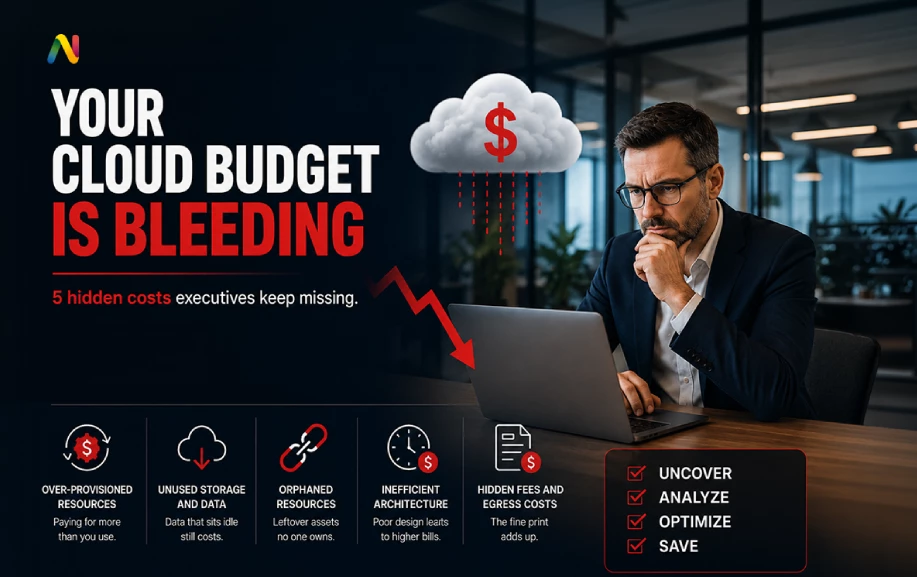
The highest hidden cost in cloud computing is unused capacity and zombie infrastructure, which executive leadership needs to address. Presently, in the year 2026, many Calgary businesses are actually seeing their IT budgets stretched thin by "pay-as-you-go" models that actually function as "pay-for-what-you-forgot-to-turn-off." Effective Calgary cloud cost management requires a shift from passive monitoring to active governance. By identifying idle resources, managing egress fees, and implementing a formal executive checklist for optimizing cloud expenditure, leaders can reclaim up to 30% of their annual cloud spend.
The Cloud Cost Crisis: Unmasking the 5 Hidden Expenses Ruining Your Budget
For many years, the cloud was sold as a way to save money. Executives in Calgary were told that moving away from physical servers would lead to lower bills and more flexibility. While the flexibility is real, the savings often vanish. This is usually because of "hidden" costs that don’t show up on a simple price sheet. If you feel like your monthly bill from AWS, Azure, or Google Cloud is a mystery, you aren't alone.
Understanding the hidden costs of AWS/Azure/GCP is the first step toward taking back control. When you look at your invoice, you see a total number. But underneath that number is a web of complex charges. Many of these charges are for things your company doesn't even use. In a city like Calgary, where business efficiency is a point of pride, letting these costs spiral out of control is not an option.
The Silent Killer: Idle Resources and Zombie Infrastructure
Imagine leaving every light in your office building on all night, every night, even when no one is there. That is exactly what happens with "zombie" infrastructure. These are cloud resources, such as virtual machines or databases, that were turned on for a specific project but left on after the project ended.
These idle resources are the primary driver of cloud waste. Because cloud providers charge by the hour or second, a single forgotten test environment can cost thousands of dollars over a year. A thorough audit of hidden cloud expenses for businesses often reveals that 20% to 35% of a company’s cloud footprint is doing absolutely nothing. For Calgary firms in the energy or finance sectors, these "ghost" servers can quietly eat through a quarterly budget before anyone notices.
Understanding Data Transfer Fees and Egress Surprises
Most cloud providers make it very easy (and free) to put your data into their systems. However, they charge you a "tax" when you want to move that data out or even move it between different regions. These are known as egress fees.
Many executives don't realize that simply accessing their own data can trigger a bill. If your team is moving large datasets between a local Calgary data center and a US cloud region, costs can skyrocket. These Hidden infrastructure fees are often tucked away in the fine print of your service agreement. Without a strategy for managing multi-cloud spending, you might find yourself paying multiple providers just to let your tools talk to each other.
The Complexity Tax: Lack of Internal FinOps Expertise
The cloud is moving faster than most internal IT teams can keep up with. Every month, providers launch new services and change their pricing models. This creates a "complexity tax." If your team doesn't have specific FinOps training for executives, they will likely choose the easiest setup rather than the most cost-effective one.
FinOps is a new way of working in which finance, tech, and business teams communicate every day. Without this, your developers might pick high-performance servers for a task that only needs a basic one. This lack of alignment is why many leaders are now seeking cloud cost optimization consulting in Calgary to help bridge the gap between their financial goals and their technical reality.
Vendor Lock-in and Reserved Instance Mismanagement
Cloud providers always desire to make you sign a long-term contract, and they often use big discounts to tempt you. Overall, this might look great on the surface, but it is a great way to save cash. However, if your business grows or changes, you might end up stuck paying for a server you don't even need for three whole years. What started out as a way to save money ends up being a total waste.
Furthermore, being stuck with one provider makes it hard to negotiate. A solid guide to avoiding cloud vendor lock-in for Canadian companies focuses on keeping your architecture portable. If you can't move your work to another provider, you have no leverage when prices go up. This is a common trap that keeps Calgary businesses overpaying for years.
Unoptimized Architecture and Storage Tiers
Not all data is created equal. Some files need to be accessed every second, while others might not be touched for a year. Cloud providers offer different "tiers" of storage for this. If you are paying for "Hot" storage (expensive and fast) for data that should be in "Cold" storage (cheap and slow), you are throwing money away.
In 2026, we see many companies failing to use automated systems to move their data to cheaper tiers. This is a core part of best practices for cloud cost optimization. Optimizing how your data is stored also lowers your Ongoing e-commerce hosting costs if you run a digital storefront. It’s about putting the right data in the right place at the right price.
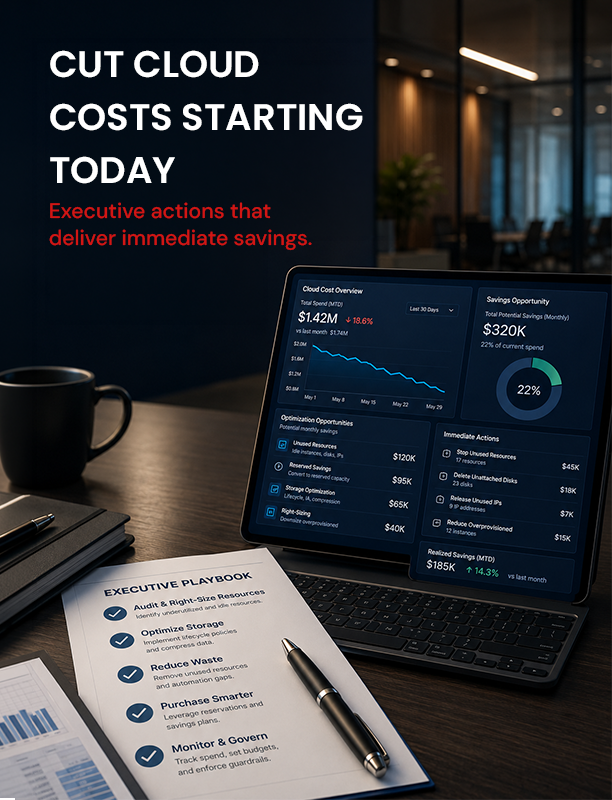
The Executive Playbook: Immediate Steps for Cloud Cost Optimization and Savings
Knowing the problem is only half the battle. As an executive, you need a clear Action plan to improve business performance regarding your IT spend. You don't need to know how to write code, but you do need to know which levers to pull to stop the bleeding.
The goal isn't just to cut costs; it's to increase the value of every dollar you spend. By following a structured Calgary enterprise guide to cloud pricing models, you can turn your cloud from a black hole of expenses into a lean, mean growth engine.
Implement Automated Resource Tagging and Governance
It is next to impossible to manage what cannot be seen. Resource tagging is like putting a digital label on every single thing you buy in the cloud. You can tag items by department, project, or even by a specific manager.
When your bill arrives, you can see exactly which department is spending the most. If the marketing team’s cloud bill tripled in a month, you can ask why. This level of visibility is essential for enterprise cloud cost management solutions. It forces accountability across the company. When developers know that their spending is being watched, they become much more careful about what they turn on.
Conduct a Quarterly Cloud Waste Audit
A one-time fix can never be enough. The cloud is dynamic; it grows and changes every day. You need a regular rhythm of checking for waste. This is where cloud waste reduction strategies come into play. A quarterly audit identifies zombie servers, unattached storage volumes, and outdated snapshots that are no longer needed.
For many Calgary businesses, it makes sense to bring in outside help for this. A specialized cloud cost-optimization consulting firm in Calgary has the tools and experience to identify issues your internal team might miss. They can provide a fresh set of eyes on your AWS/Azure/GCP hidden costs and often find enough savings in the first week to pay for their entire fee.
Strategic Negotiation: Leveraging Your Volume for Better Provider Contracts
If your company spends a significant amount on the cloud, you shouldn't be paying "retail" prices. Cloud providers have sales teams authorized to offer discounts to large enterprises. However, you have to know how to ask.
As part of your executive checklist for optimizing cloud expenditure, you should review your contracts at least once a year. Look at your total volume across all departments. Can you commit to a certain level of spend in exchange for a lower rate? Can you negotiate better terms for data egress? In a competitive market like Calgary, being a smart negotiator can save you six figures on your annual bill.
Beyond Savings: Positioning Your Business for Cloud Authority and Growth
Once you have mastered reducing AWS costs in Calgary and other providers, you can shift your focus to the future. Cloud optimization isn't just about being cheap; it's about being fast and smart. When you aren't wasting money on "zombies," you can reinvest that cash into things that actually grow your business, like Artificial Intelligence or better customer experiences.
Smart executives also look at the bigger picture of sustainability. In 2026, the environmental impact of data centers is a major talking point. Optimizing your cloud doesn't just save money; it also reduces your carbon footprint. Many leaders are finding that Sustainable cloud hosting costs are lower in the long run because it requires less energy and fewer resources.
By following these cloud cost optimization best practices, you position your Calgary business as a leader in the digital economy. You demonstrate to your board and shareholders that you are a responsible steward of the company’s resources. You move from being a "victim" of cloud pricing to a master of it.
Executive Checklist for Cloud Cost Mastery
- Audit Daily: Do we really have an automated tool that flags idle resources?
- Tag Everything: Is 100% of our cloud spend assigned to a specific cost center?
- Review Tiers: Always cross-check that you are using the cheapest possible storage to save our old data.
- Negotiate Yearly: When was the last time we spoke to our cloud rep about a custom discount?
- Train the Team: Does our IT lead understand FinOps for executives?
Conclusion: Stop Hiding in Plain Sight
The cloud is considered a powerful tool, but it can also be dangerous to your budget if left unmanaged. Calgary executives who take the time to understand Calgary cloud cost management are the ones who will thrive in the coming years. Don't let your cloud bill be a mystery that you accept every month. Demand visibility, enforce accountability, and start cutting the waste today.
You have worked too hard to build your business to let "zombie" servers eat your profits. Take control of your digital infrastructure and turn the cloud back into the competitive advantage it was always meant to be.
Ready to Reclaim Your IT Budget?
If you are tired of soaring cloud bills and want a clear path to savings, Netclues is your partner in Calgary. We specialize in high-impact enterprise cloud cost management solutions that find the hidden waste other firms miss. Whether you need a one-time hidden cloud expenses audit for businesses or a long-term cloud cost optimization consulting partner in Calgary, we have the technical expertise and local presence to help you win. Let us help you turn off the lights on your zombie infrastructure and put that money back where it belongs: into your company’s growth.
Contact Netclues today to schedule your cloud cost audit and start saving!
Calgary Cloud Cost Optimization: Frequently Asked Questions
Q.1. What is Calgary cloud cost management?
A. Calgary cloud cost management is the practice of monitoring, governing, and optimizing cloud spending for businesses operating in Calgary. It typically covers compute, storage, databases, data transfer, licensing, contracts, and resource utilization. Effective programs combine financial visibility with technical controls so organizations can reduce avoidable spending while keeping workloads secure, available, and aligned with business requirements.
Q.2. Why are cloud bills higher than expected?
A. Cloud bills can increase because of idle virtual machines, oversized resources, unattached storage, excessive snapshots, inefficient storage tiers, data transfer charges, and workloads that run longer than necessary. Multi-cloud environments can add further complexity. A detailed cost analysis should separate legitimate business growth from avoidable waste before any cost-cutting decisions are made.
Q.3. What are zombie resources in cloud computing?
A. Zombie resources are cloud resources that remain active even though they are no longer required. Examples include unused virtual machines, development environments, unattached disks, obsolete snapshots, and forgotten databases. Because cloud services can continue generating charges while unused, organizations should use automated detection, ownership tags, expiration policies, and regular audits to identify and remove unnecessary resources.
Q.4. How can businesses reduce AWS, Azure, or Google Cloud costs?
A. Businesses can reduce cloud costs by identifying idle resources, rightsizing workloads, selecting appropriate storage tiers, improving scheduling, reviewing data transfer patterns, and using suitable commitment or discount programs. Resource tagging and budget alerts also improve accountability. The right approach depends on workload requirements, utilization patterns, contracts, architecture, and availability requirements rather than simply choosing the cheapest service.
Q.5. What is FinOps and why does it matter for cloud cost optimization?
A. FinOps is a collaborative operating practice that connects finance, engineering, operations, and business teams around cloud economics. It helps organizations understand who is spending money, why the spending occurs, and what business value it produces. FinOps can improve accountability by combining cost visibility, shared ownership, forecasting, optimization, and continuous decision-making.
Q.6. How much can a business save through cloud cost optimization?
A. There is no universal savings percentage because cloud waste varies significantly by organization, workload, architecture, utilization, and governance maturity. A credible optimization assessment should first establish a baseline and identify specific opportunities. Potential savings may come from rightsizing, eliminating unused resources, changing storage tiers, improving scheduling, or renegotiating commercial terms rather than applying one blanket reduction target.
Q.7. How often should a company conduct a cloud cost audit?
A. Cloud environments benefit from continuous monitoring combined with formal periodic reviews. Many organizations can use automated alerts and dashboards daily while conducting a more comprehensive cost review monthly or quarterly. Larger or rapidly changing environments may require more frequent reviews. The appropriate cadence depends on cloud spend, workload volatility, organizational ownership, and how quickly costs can change.
Q.8. Does cloud cost optimization affect performance or security?
A. It can if optimization is performed without proper governance. Aggressively reducing resources or changing configurations without understanding workload requirements may create performance, availability, or security problems. Effective optimization uses utilization data, service requirements, architecture dependencies, and security controls to distinguish unnecessary capacity from capacity that is genuinely required.
Q.9. What is the difference between cloud cost optimization and cloud migration?
A. Cloud migration focuses primarily on moving applications, data, or infrastructure from one environment to another. Cloud cost optimization focuses on making the resulting environment economically efficient. The two activities can overlap, because migration architecture decisions influence future costs. Organizations should consider cost, performance, security, resilience, operational requirements, and business objectives when designing a cloud environment.
Q.10. How can companies control cloud data transfer and egress costs?
A. Companies can control data transfer costs by understanding where data moves, why it moves, and how frequently it moves. Teams can review cross-region traffic, internet egress, inter-service communication, replication, backups, and multi-cloud data flows. Architecture changes, caching, data locality, transfer-efficient designs, and appropriate service configurations may reduce unnecessary movement without compromising application requirements.
Q.11. Should a business use reserved capacity or long-term cloud commitments?
A. Reserved capacity or other commitment-based pricing can reduce unit costs when workloads are sufficiently predictable. However, commitments can create financial risk if usage falls, workloads migrate, or business requirements change. Companies should analyze historical utilization, growth expectations, workload stability, cancellation or exchange options, and contract terms before committing. Flexible and predictable workloads may require different purchasing strategies.
Q.12. How can Calgary businesses start a cloud cost optimization program?
A. Start by establishing a baseline of current cloud spending and assigning costs to accounts, applications, departments, or projects. Then identify idle resources, rightsizing opportunities, storage inefficiencies, data transfer costs, and commitment opportunities. Introduce ownership tags, budgets, alerts, governance policies, and recurring reviews. For complex environments, a cloud cost audit can provide an independent starting point.