


In the year 2026, there can be seen a major shift in the healthcare landscape in the USA . When a person feels a strange ache or a sudden fever, the first person they talk to is often not a doctor. It is a bot. This trend is growing fast because health insurers and telehealth startups want to save money. By using a bot to check a patient's symptoms first, they can decide if that person really needs an expensive doctor visit or just some rest at home.
However, building these tools is not like making a simple app for weather or games. There are huge legal risks involved. If the bot gives bad advice, a person could get hurt. This is why a business needs a specialized healthcare AI development company that knows the difference between a helpful chat and a dangerous mistake. You cannot just use a generic AI tool for this work. It requires deep knowledge of medicine and the law.
Quick Breakdown: Legal vs. Development Costs
Category | Estimated Budget (USD) | Key Focus Areas |
Development Cost | $60,000 – $150,000 | NLP engines, medical datasets (PubMed/Mayo), integration. |
Legal & Compliance | $20,000 – $50,000+ | FDA consultation, malpractice insurance, lawyer reviews. |
Why is AI Triage the New Front Door of Healthcare?
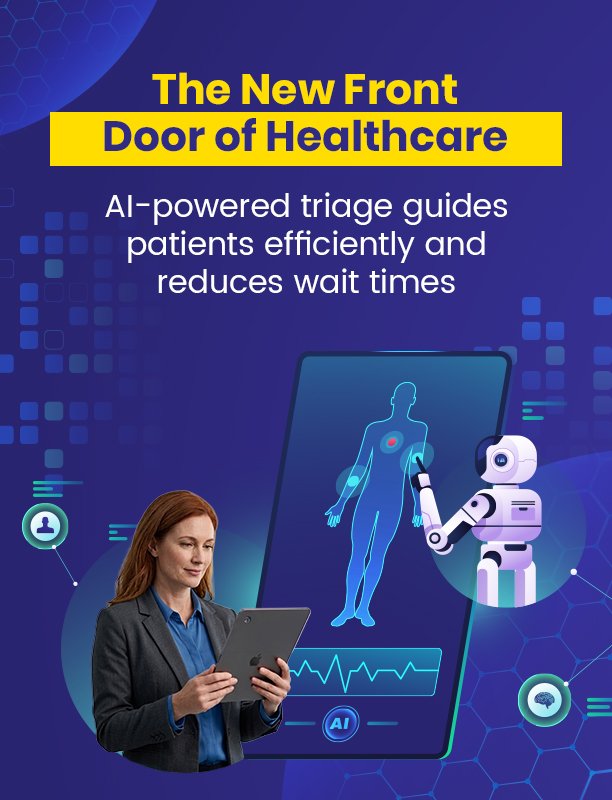
The main goal of a triage bot is to act as a "front door." Instead of a patient going straight to the Emergency Room for a minor cold, the bot guides them to the appropriate care. This saves the insurance company thousands of dollars per visit. It also helps doctors focus on patients who are truly in danger. For a startup, this is a massive business opportunity, but the barrier to entry is high because of the need to build a medical triage bot that is actually safe.
Cost to Build an AI Symptom Checker in the USA
Building a bot that understands medicine is expensive and takes time. A standard symptom-checker app development project usually costs between $80,000 and $200,000 for a version ready for the public. This cost is high because the software must be extremely smart.
To get this right, a company must hire AI developers for healthcare who have experience with medical data. The bot needs to be trained on large datasets from sources such as the Mayo Clinic or PubMed. If the bot learns from bad data, it will give bad advice.
The Role of NLP in Medical Bots
A huge part of the budget goes into Natural Language Processing (NLP) in healthcare. This is the technology that lets the bot understand a human. If a person says, "I have a crushing feeling in my chest," the NLP needs to know that this is much more serious than saying, "My chest feels a bit tight after exercise."
Developing this level of understanding requires millions of examples and constant testing. This is why medical chatbot development services are more expensive than regular app development. The bot must understand slang, typos, and even a patient's "vibe" when expressing worry.
Ada Health vs Babylon Clone Cost
Many startups want to build a "clone" of famous apps like Ada Health or Babylon. A very simple version that just asks basic questions might cost around $75,000. But if a company wants to compete with the big players, they need deep features.
This includes connecting to a doctor's live calendar or looking at a patient's real-time medical history. When an app can see that a person has a history of heart issues, its advice becomes much more valuable. For a full-scale platform that does all of this, the investment can easily go over $250,000.
Legal Risks of Using AI for Medical Triage
The biggest fear for any health tech founder in the USA is medical malpractice liability. In America, people can sue if they feel a service gave them advice that led to an injury. If a bot tells someone with a serious infection to just "wait and see," the company could face a lawsuit that costs millions.
In the eyes of the law, these bots are often seen as clinical decision support systems (CDSSs). This is a specific legal term. It means the software is helping make health choices. To stay safe, the development process must include a legal review. Lawyers must check every single answer the bot is allowed to give. This ensures the bot is not "practicing medicine" without a license.
Algorithmic Bias Testing
Another legal risk is bias. If an AI were only trained on data from one group of people, it might not work well for others. For example, some symptoms may look different across skin tones or in men versus women.
A responsible company must perform algorithmic bias testing. This is a process where testers try to "break" the bot by giving it symptoms from many different types of people. If the bot gives different levels of care based on race or gender, it is a legal disaster waiting to happen. Solving this early is a key part of HIPAA-compliant AI development.
For more information on how to protect a tech business from these types of legal troubles, consider specialized legal IT solutions.
FDA Approval for Symptom Checker Apps
The US government is very strict about health tools. The FDA (Food and Drug Administration) mentions a clear category called FDA SaMD (Software as a Medical Device). This means the software itself is treated like a medical tool, just like a heart monitor or a scalpel.
Not every bot needs full FDA approval. If a bot just gives general information, it might be low-risk. But if the bot tells a person they have a specific disease, it becomes a medical device. Getting through the FDA process is hard and expensive. It can add $30,000 to $100,000 to a budget and take a year.
A company must also prove ISO 13485 compliance (Quality management). This is an international standard that demonstrates the company has a high-quality approach to building and testing its software. Without this, the FDA will likely reject the app.
How to Insure an AI Medical Bot?
A business cannot launch a medical bot without the right insurance. Standard business insurance will not cover a bot that gives health advice. A founder needs a special policy called "Tech E&O" (Errors and Omissions) that specifically mentions AI.
To get this insurance, the company must prove the bot is safe. Insurance companies will want to see the "brain" of the bot. They look for the use of Triage algorithm protocols (Schmitt-Thompson). These are the gold-standard rules used by nurses worldwide. If the bot follows these proven rules, the insurance company will feel much safer giving a policy.
HIPAA and Data Privacy in AI
In the USA, any app that handles health data must comply with HIPAA. This means the data must be locked away so that no one can steal it. HIPAA-compliant AI development means every piece of information is encrypted.
When a person tells a bot about a private health issue, that data is very sensitive. If there is a hack, the fines can be high enough to put a business out of business. Part of the development cost goes into building "digital walls" to keep this data safe. This includes using secure cloud servers and ensuring that developers cannot see the patients' private names.
Disclaimer UI for Medical Chatbots
The app's design is just as important as the code. A bot must have a very clear "Disclaimer." Every single chat should start with a message that says: "This is not a doctor. This is for information only."
The buttons and text must be easy to read. If a person is in pain, they are often confused or tired. The symptom checker app development team must focus on a "User Interface" (UI) that is simple enough for anyone to use without making a mistake.
Must-Have Feature: The "Escape Hatch"
The most important feature in any triage app is the "Escape Hatch." This code constantly searches for "Emergency Keywords."
If a user types something like "I have chest pain" or "I cannot breathe," the bot should stop the chat immediately. It should not ask another question. Instead, it should display a large red button labeled "Call 911" or "Go to the Emergency Room." This feature saves lives. It also shows that the company is acting responsibly. This is a core part of any medical chatbot development services package.
The Technology Stack for Medical AI
To keep costs under control, the right tools must be used. Choosing the wrong technology can lead to bugs that are expensive to fix later.
- Backend: Most teams use Python for the AI components because it has the best libraries for medical applications.
- Frontend: Tools like Flutter or React Native enable a single team to build for both iOS and Android simultaneously.
- Security: Using specialized "Healthcare Clouds" such as AWS HealthLake ensures that data remains HIPAA-compliant.
Summary
Building an AI triage app in 2026 is a big opportunity, but it is not a simple task. A founder must balance the high costs of developing a symptom checker app with the legal requirements of the US market. By focusing on HIPAA-compliant AI development and following the FDA SaMD rules, a company can build a tool that truly helps people while staying safe from lawsuits.
The key to success is not just good code. It is about building trust. Trust from users, from the government, and from insurance companies. Working with an experienced healthcare AI development company is the best way to ensure trust from the very first day.
Are you ready to build a safe and powerful health bot?
Netclues offers expert medical chatbot development services that prioritize safety and compliance. The team helps navigate everything from NLP in healthcare to complex FDA rules.
Contact Netclues today for a free consultation on a new AI healthcare project.
Frequently Asked Questions About AI Symptom Checker Development
Q. 1. How much does it cost to build an AI symptom checker app in the USA?
A. The cost of developing an AI symptom checker typically ranges from $80,000 to $250,000+, depending on AI capabilities, compliance requirements, integrations, and platform complexity. An MVP with basic symptom assessment costs less, while enterprise-grade solutions with EHR integration, advanced NLP, and analytics require a higher investment.
Q. 2. Does an AI symptom checker need to comply with HIPAA?
A. Yes. If your AI symptom checker collects, stores, or processes protected health information (PHI), it should comply with HIPAA. Compliance includes data encryption, secure cloud infrastructure, access controls, audit logging, and privacy safeguards to protect sensitive patient information.
Q. 3. Does an AI triage app require FDA approval?
A. Not always. AI symptom checker apps that provide general health information may not require FDA clearance. However, if the software diagnoses diseases, recommends treatments, or functions as Software as a Medical Device (SaMD), it may fall under FDA regulatory oversight.
Q. 4. What technologies are commonly used to develop AI medical chatbots?
A. Most healthcare AI applications use Python for AI development, Natural Language Processing (NLP) for symptom analysis, React Native or Flutter for mobile apps, and cloud platforms such as AWS or Azure. Integration with healthcare standards like FHIR and HL7 is also common.
Q. 5. How long does it take to develop an AI symptom checker?
A. Development timelines typically range from 4 to 12 months, depending on project scope. A basic MVP can be launched within a few months, while enterprise healthcare platforms with AI training, compliance testing, and EHR integrations require longer development cycles.
Q. 6. What are the biggest legal risks of AI symptom checker apps?
A. The primary legal risks include inaccurate medical guidance, regulatory non-compliance, patient privacy violations, algorithmic bias, and potential malpractice claims. Regular clinical validation, legal reviews, and transparent disclaimers help reduce these risks.
Q. 7. Can AI symptom checkers integrate with electronic health record (EHR) systems?
A. Yes. Modern AI triage applications can integrate with EHR and EMR systems using standards such as FHIR and HL7. This enables secure access to patient history, improves clinical decision support, and enhances the overall patient experience.
Q. 8. How can AI reduce healthcare costs through symptom triage?
A. AI symptom checkers help reduce unnecessary emergency room visits, automate patient intake, improve care routing, and assist healthcare providers in prioritizing urgent cases. This leads to lower operational costs, improved resource utilization, and faster patient support.
Q. 9. What security features should an AI healthcare application include?
A. Healthcare AI applications should implement end-to-end encryption, multi-factor authentication, role-based access controls, secure APIs, audit trails, regular vulnerability assessments, and continuous monitoring to safeguard sensitive medical data and maintain regulatory compliance.
Q. 10. Why should businesses partner with a healthcare AI development company?
A. Developing an AI healthcare application requires expertise in artificial intelligence, healthcare regulations, cybersecurity, compliance, and medical workflows. An experienced healthcare AI development company can help accelerate development, reduce compliance risks, and build scalable, secure solutions that meet industry standards.