



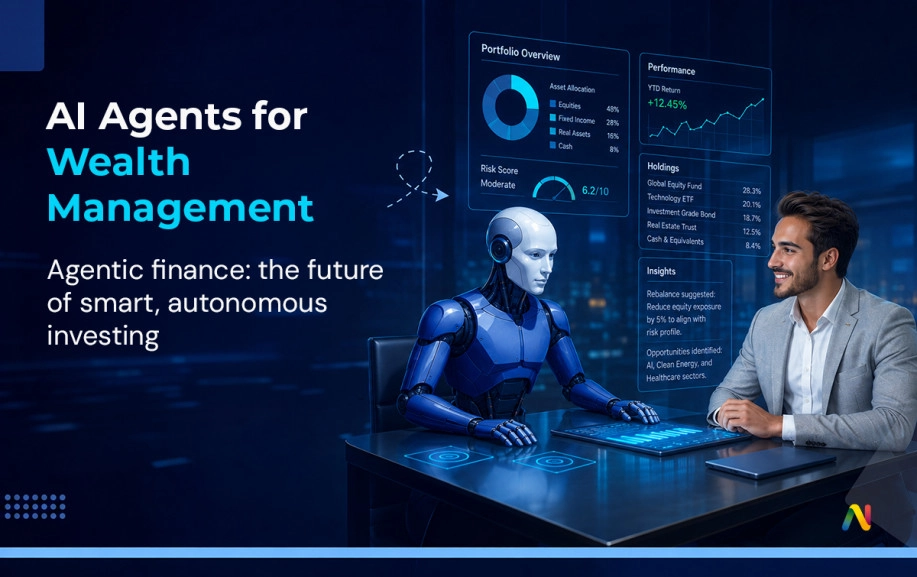
It won't be wrong to mention that robo-advisors are dead. The future belongs to AI that takes action. In 2026, we have moved past simple apps that just show you charts of your spending. We are now in the era of Agentic Finance. As a premier FinTech software development company, we help global startups build Agentic AI that doesn't just analyze wealth, it actively manages it. Imagine an AI assistant suggesting you to save more, and actually finding the best savings account, while moving the money for you. This amazingly massive shift is deeply transforming how people interact with their money, turning passive observers into successful investors through the power of automation. By building these smart systems, we are giving everyone access to the kind of high-level wealth management that used to be only for the very rich.
- Trend: AI that doesn't just give advice but executes trades or moves money to savings accounts.
- Target Audience: FinTech Startups, Wealth Management Firms.
Generative AI vs. Agentic AI: The Evolution of Wealth Management
To understand where we are going, we first have to look at where we have been. For the last few years, everyone has been talking about "Generative AI." This is the kind of AI that can write a poem or answer a question. In finance, Generative AI acts like a very smart advisor. It can look at your bank statement and say, "I noticed you spent $200 on coffee this month; you should move $500 to your savings instead." While this is helpful, it still requires you to do the work. You have to log in to your bank and make the transfer.
Agentic Finance is different. It uses "Agentic AI" which acts like a person with a job to do. Instead of just giving you advice, it executes the task. For example, the AI might suggest, "I noticed that you clearly have this amount of extra cash in your checking account that isn't earning interest. I securely transferred $500 to your high-yield savings via Plaid to make sure you earn more money today." This is a huge leap forward in Wealth management app development. One is a coach, but the other is a doer. This transition is one of the most exciting AI trends for business strategy we are seeing this year.
How does Agentic AI execute trades autonomously via API?
Building an AI that can actually "do things" requires a very specific tech stack. Think of the Large Language Model (LLM) as the "brain." It understands what you want to achieve. However, a brain without hands can't move anything. To give the AI "hands," we use tools like LangChain or AutoGPT. These tools allow the AI to call a financial API (Application Programming Interface).
When you hire AI FinTech developers, they build the connections between the brain and the hands. For example, if the AI decides the stock market is looking good for a specific tech company, it doesn't just tell you. It uses an Algorithmic trading API integration (e.g., Alpaca, Interactive Brokers) to place the trade for you. It sends a secure message to the broker saying, "Buy 10 shares of this stock at this price." Because this happens through a secure "handshake" between computers, it is much faster and more accurate than a human could ever be. This is why many firms are now looking for a specialized AI trading bot development company to build these autonomous systems.
Want to know what’s shaping the future of finance?
Explore the latest fintech app trends transforming the industry.
Learn how AI, DeFi, Blockchain, and emerging technologies are leading the way in 2025.
Cost to build an AI wealth management agent in 2026
Building a high-quality financial agent is a significant investment. Because we are dealing with real money and strict laws, you cannot cut corners. Here is how the costs usually break down in 2026:
- Basic AI Financial Assistant (Read-Only): $60,000 – $100,000. This version can look at your data and give you great advice, but it cannot move money or trade for you. It is a great starting point for many fintech app trends.
- Autonomous Wealth Agent (Action-Oriented via APIs): $150,000 – $300,000+. This is the "Full Agent" that can trade stocks, rebalance your portfolio, and move money between accounts.
- Major Cost Drivers: The biggest expenses are not just the code itself. They come from strict security audits, achieving SOC2 compliance, and connecting the AI to live banking systems. You also need to pay for RAG (Retrieval-Augmented Generation) for finance, which helps the AI stay updated on the latest market news and your personal financial goals.
To manage these costs and ensure a high-quality product, many startups choose agentic AI development services to get a team that already has the "blueprints" for success.
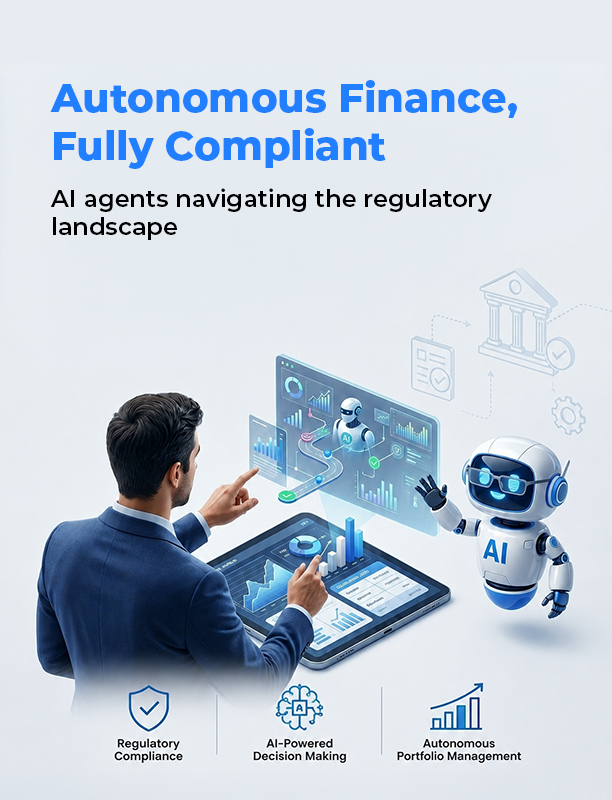
Navigating SEC and FCA compliance for autonomous financial AI
Financial regulators like the SEC in the USA and the FCA in the UK are very careful about AI. They are worried that if everyone's AI decides to sell a stock at the exact same time, it could cause a market crash. This is why KYC/AML compliance automation is a must-have feature for any app. You must know exactly who is using the AI and where their money is coming from.
When you hire dedicated AI developers, their job is to build "guardrails" into the code. These guardrails make sure the AI stays within the law. For example, the AI might have a limit on how much it can trade in one day, or it might be blocked from buying "risky" stocks unless a human says it's okay. Building these legal safety nets is just as important as building the AI itself. This is a task that requires a professional generative AI development company that understands the heavy weight of financial law.
Integrating Plaid and Open Banking for automated fund transfers
For an AI to move money, it needs to be able to "see" into all your bank accounts. This is where Open Banking integrations (Plaid, Tink) come in. Plaid acts like a secure bridge between your app and thousands of different banks.
By using these integrations, your AI agent can see that you have $2,000 in a checking account that is earning 0% interest and a savings account that is earning 4% interest. The Autonomous wealth management algorithms can then calculate exactly how much money you need for your bills and move the rest to the savings account. This "Cash Flow Routing" ensures that every dollar you own is working as hard as possible for you every single day. This is one of the top reasons businesses hire AI ML developers to create smarter financial tools.
Security risks: Building "Human-in-the-Loop" safeguards
With great power comes great responsibility, and also great risk. If an AI has the power to move your money, security must be the number one priority. We follow strict Financial data security (PCI-DSS / SOC2) rules to make sure that no one can "hack" the AI and steal your funds. This involves encrypting every message and using multi-factor authentication for every big move.
However, even the best AI can make a mistake. This is why we use Human-in-the-loop (HITL) trading. This means that for very large trades or unusual moves, the AI stops and asks a human for permission. For example, the AI might say, "I want to sell 50% of your portfolio because of a major market shift. Do you approve?" This keeps the human in control of the "big picture" while the AI handles the boring daily tasks. It is a partnership that combines human wisdom with AI speed. You might even hire prompt developers to ensure the AI explains its reasoning to the human in a way that is easy to understand.
Key Capabilities of Financial AI Agents:
- Autonomous Trading: Executing stock or crypto trades via APIs (like Alpaca) based on real-time market sentiment analysis.
- Dynamic Rebalancing: Automatically adjusting portfolio weights without human intervention to stay on track with your goals.
- Cash Flow Routing: Moving funds between checking, savings, and investment accounts to maximize daily APY.
Final Verdict: The Future of Your Wallet
Agentic Finance is definitely changing the world as it truly understands and respects the time. In the earlier days, managing wealth somewhere felt like a second job. It was needed to stay updated on the news, check stocks, and move money manually. In 2026, the AI does the "heavy lifting." This allows you to focus on your life while your money grows in the background.
Building autonomous financial AI requires more than just API knowledge; it requires a fortress of security. You need a partner who understands the "hands" and the "brain" of the system. Agentic AI development services are the key to building a platform that people can trust with their life savings.
Start Building the Future of Finance with Netclues
Building a smart financial tool is a big step, and you don't have to do it alone. At Netclues, we have the experience to build secure, smart, and legal AI agents that your customers will love. Whether you need to hire AI FinTech developers or want a full-team solution, we are ready to help. Visit our website today to see how we can turn your big idea into a real-world success.
Agentic Finance FAQs: Everything You Need to Know in 2026
Q. 1. What is Agentic Finance?
A. Agentic Finance uses autonomous AI agents to analyze financial data, make decisions, and execute actions such as transferring funds, rebalancing portfolios, or placing trades based on predefined rules and user permissions. Unlike traditional financial apps, it automates wealth management while keeping users in control.
Q. 2. How is Agentic AI different from Generative AI in wealth management?
A. Generative AI provides financial insights, recommendations, and reports, while Agentic AI takes action. It can execute trades, automate savings, rebalance portfolios, and manage financial workflows through secure API integrations, reducing manual effort and improving operational efficiency.
Q. 3. How do AI agents automate investing and wealth management?
A. AI agents combine large language models (LLMs), financial APIs, market data, and automation frameworks to monitor investments, evaluate market conditions, optimize cash flow, and execute approved transactions based on predefined goals, risk tolerance, and investment strategies.
Q. 4. How much does it cost to build an Agentic Finance platform?
A. Development costs typically range from $60,000–$100,000 for an AI-powered financial assistant and $150,000–$300,000+ for an enterprise-grade Agentic Finance platform with autonomous trading, Open Banking integration, compliance modules, and advanced AI capabilities.
Q. 5. Is Agentic Finance compliant with financial regulations?
A. Yes. Agentic Finance platforms can comply with regulations such as SEC, FCA, KYC, AML, SOC 2, and PCI-DSS when built with secure identity verification, audit trails, transaction monitoring, and governance controls to protect users and financial data.
Q. 6. Which APIs are commonly used in Agentic Finance platforms?
A. Popular integrations include Plaid and Tink for Open Banking, Alpaca and Interactive Brokers for trading, payment gateways, market data providers, identity verification services, and portfolio management APIs that enable secure financial automation.
Q. 7. What security features should an AI wealth management platform include?
A. A secure platform should implement end-to-end encryption, multi-factor authentication, secure API authentication, role-based access control, continuous monitoring, audit logs, fraud detection, Human-in-the-Loop approvals, and compliance with financial security standards.
Q. 8. What is Human-in-the-Loop (HITL) in Agentic Finance?
A. Human-in-the-Loop (HITL) ensures AI agents can automate routine financial tasks while requiring user approval for high-value transactions, unusual trading activity, or major portfolio changes. This balances automation with transparency, trust, and regulatory compliance.
Q. 9. What features should a modern Agentic Finance platform include?
A. Core features include autonomous trading, portfolio rebalancing, automated savings, Open Banking integration, AI financial planning, KYC/AML verification, investor dashboards, real-time analytics, risk management, compliance monitoring, and secure API integrations.
Q. 10. Why choose Netclues for Agentic Finance development?
A. Netclues develops secure, scalable, and compliance-ready Agentic Finance solutions powered by autonomous AI agents, Open Banking integrations, intelligent automation, and enterprise-grade security. Our team helps FinTech startups and wealth management firms build next-generation AI-powered financial platforms.