


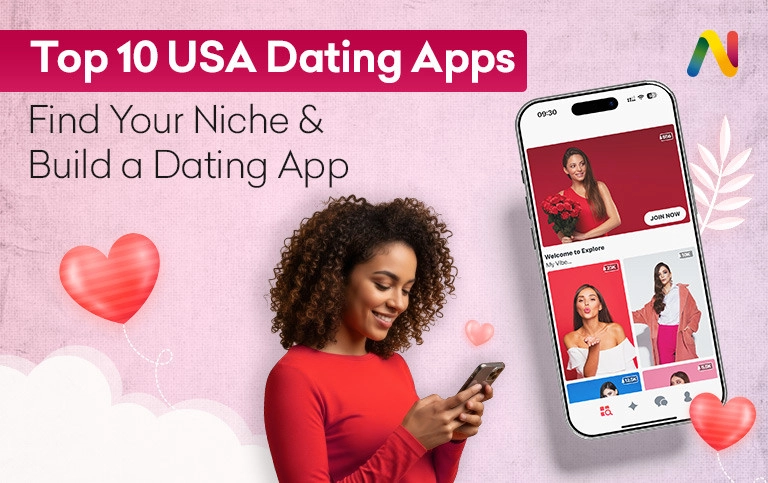
Dating apps have changed the way relationships start. What was once seen as unconventional is now one of the most common ways relationships begin. In the United States, millions of people actually connect on a daily basis using dating platforms, getting into friendships, long-term relationships, and even marriages through a swipe, match, or message technique. This digital shift continues to accelerate as people become more comfortable in expressing themselves online.
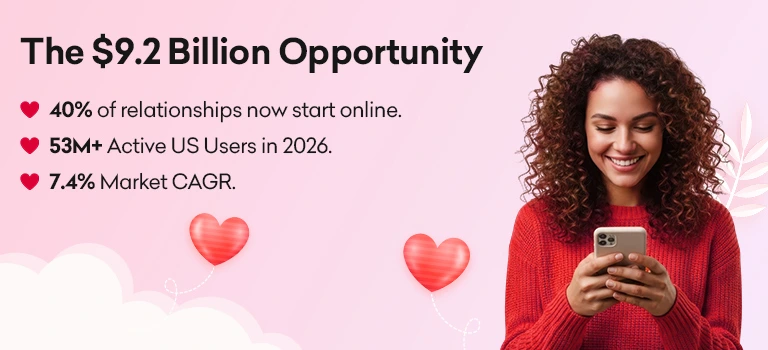
According to the Statista report, approximately 53 million plus Americans are the active dating app users in the year 2026. Also, the number is further rising each year. The convenience, accessibility, and algorithm-driven personalization have definitely made dating apps a key part of social life. This growth definitely shows that online matchmaking is no longer optional, but is indeed a mainstream part of how Americans build connections.
Today, dating apps are not just tools; they are ecosystems that influence how modern relationships start. Meeting someone online is almost as normal as meeting them at work or through friends. Relationship building majorly starts with a swipe in the United States, and the trend is rising.
This market might seem saturated, but it has great room for alignment with other apps aligned to the user’s lifestyle, identity, and values. This particular shift opens the door for new, innovative platforms to succeed, especially niche-based dating apps designed for focused communities.
This article explores the Top 10 dating apps in the USA in 2026, why they work, and what entrepreneurs can learn if they aim to build their own successful matchmaking platform.
RankApp | Why Does It Work? |
Tinder | The swipe feature keeps it simple and fun; great for casual dating and quick matches |
Bumble | Women send the first message — makes many users feel more confident and safe. |
Hinge | Focuses on real conversations with prompts instead of just pictures. |
Match.com | A very reliable option for people looking for serious relationships. |
OkCupid | Uses personality questions to suggest better matches. |
Grindr | Popular app for the LGBTQ+ community; built around specific needs and identity. |
Plenty of Fish | Open platform for people who prefer fewer restrictions and more flexibility. |
Happn | Connects people who have crossed paths in real life — makes matching feel natural. |
eHarmony | Known for compatibility tests; designed for long-term relationships. |
Niche Dating Apps | These serve groups based on interests, lifestyle, age, or values — a small but loyal user base. |
Dating App Statistics
- Around 30% of US adults have used a dating app at least once.
- Young adults remain the most active users, especially those under 30.
- Safety and trust are the top concerns for women using dating platforms.
- Many relationships and marriages now begin online, not offline.
This tells us something important: people are open to online matchmaking, but they only want apps that feel safe, genuine, and personalised.
For better tech decisions, it's best to hire mobile app developers from reputable app development companies.
Let us have a closer look at understanding and ranking apps while understanding how they work:
1. Tinder: The simplicity that revolutionized dating
Tinder is still one of the most recognizable dating apps in the world, and its simple swipe design continues to rule the casual dating space. A big part of its appeal is how quick and effortless it feels. You open the app, swipe a little, and you instantly meet new people. Over time, Tinder has also grown up. It now includes better safety tools, stronger verification, and even AI-supported features that reflect what users care about today. The “Relationship Goals” update is a good example. It helps people share what they want, which moves the experience from purely casual interactions to something more thoughtful when needed.
2. Bumble, where women take the lead
Bumble’s core idea is much simpler and it follows a rule of giving women the first move, and that one change has completely reshaped how people approach online dating. Many users say they feel safer, more respected, and more in control when using the app. Bumble always puts much emphasis on the community guidelines, seeking consent, and healthy behaviour, which makes it quite popular with women. The platform has also grown beyond dating. With Bumble BFF and Bumble Bizz, it now supports friendships and professional networking as well. This broader approach has helped the app build strong user loyalty and higher daily engagement.
3. Hinge: best for meaningful conversations
Hinge stands out with its profile prompts and conversation starters rather than relying solely on photos. This encourages users to put thought into their profiles, resulting in deeper interactions from the beginning. Their tagline, “Designed to be deleted,” continues to be one of the most effective branding moves in the dating industry. Hinge’s matching algorithm has also become more refined through machine learning, studying user behaviours to suggest better connections. Their strong emphasis on “quality matches over quantity” is a key reason for their success.
4. Match.com: Ideal for serious relationships
Match is a strong choice for people who want long-term relationships. As one of the oldest dating platforms, it has years of data that help improve its compatibility system. Users like the detailed profiles, background preferences, and safety features. The app mainly attracts a mature audience between 30 and 50 who prefer stability and clarity instead of casual browsing.
5. OkCupid: A highly personality-driven matchmaking
OkCupid uses a unique questionnaire-driven matching system that helps identify compatibility on everything from lifestyle to values. It is highly popular among intellectuals, millennials, and people who genuinely appreciate deeper and stronger compatibility instead of merely a surface-level attraction. The platform is inclusive and progressive, offering dozens of gender and orientation identities, which is one reason it maintains popularity among diverse communities. Their data-driven matchmaking continues to evolve with updated questions that reflect modern values and beliefs.
6. Grindr: A respected platform for the LGBTQ+ community
Grindr transformed LGBTQ+ dating by offering a space designed for their needs. It remains the leading platform for gay, bi, trans, and queer users, thanks to its quick, location-based matching. Recent updates include stronger safety tools, location masking, and resources for users in less supportive regions. Its community-focused approach shows how powerful niche apps can be when they understand user identity.
7. Plenty of Fish: Perfect for those wanting flexibility:
Plenty of Fish (POF) attracts people who prefer fewer restrictions and more freedom in communication. Unlike apps with limited daily likes or strict matching systems, POF allows open browsing and interactions, making it ideal for users who enjoy an unrestricted experience. With over 100 million registered users worldwide, POF continues to benefit from its large community and long-standing presence in the.
8. Happn: It encourages matches precisely as per real-life encounters
Happn is winning hearts by offering a unique romantic twist as it well-connects the users who have crossed paths in real life. The principle makes the identified matches to feel safe, authentic, and linked to shared environments. For reference, the app users may discover people they passed in any cafe, while commuting, or somewhere in their neighbourhood. This hyperlocal style greatly appeals to users craving real-world connections influenced by urban lifestyle and proximity. As urban populations grow, Happn’s approach becomes increasingly relevant.
9. EHarmony: A perfect app for highly science-backed compatibility
eHarmony is a credible yet unique platform extending special attributes such as compatibility testing and psychology-driven matchmaking. Also, this specific application has one of the most reported apps that offers marriage success rates, making it a top choice for serious relationships. The platform invests heavily in research, user behaviour studies, and personality mapping. Their advanced algorithms predict relationship success by analysing detailed personality traits, emotional compatibility, and communication styles.
10. Niche Dating Apps: Small audience, big loyalty
Niche dating apps cater to specific interests, communities, lifestyles, religions, and age groups. Examples include: Dating for vegans, pet lovers, fitness enthusiasts, gamers, seniors, faith-based dating platforms, and apps for specific ethnic or cultural groups. These special preference apps break away from the “one-size-fits-all” model and offer users a space where they feel understood. Their audiences may be smaller, but the engagement, loyalty, and retention rates are significantly higher.
Dating App Statistics to consider for 2026
A large number of Americans now have complete trust in online platforms for finding genuine and meaningful relationships. Recent statistics highlight how fast the industry is evolving:
- Nearly 30 percent of US adults have used a dating app at least once.
- 71 percent of adults who are aged below 30 are using or have definitely used dating apps, making them the most active age group.
- Women across the globe have cited safety and trust as among the top-most concerns, driving demand for verification features.
- Over 40 percent of US relationships now start online.
- Online dating revenue is expected to hit $9.2 billion by 2027, driven by AI and personalization.
These figures prove that online dating habits are shifting dramatically. People are not just open to digital matchmaking, but they also prefer the same when apps feel safe, authentic, and aligned with their lifestyle.
One's hiring decision impacts costs. You can hire Android developers, or hire mobile developers from a mobile application development company, or outsource the project entirely to Android/iOS application development companies in the vicinity of the USA for enterprise-grade quality.
Why Do New Dating Apps Still Succeed?
People don't just want to meet anyone, but they want to meet someone who understands their lifestyle, values, culture, humour, and lifestyle choices. People now are more keen on compatibility rather than convenience. The shift is the prime reason that niche-based dating platforms are witnessing a boom.
Some of the most common groups seeking tailored matchmaking are listed here:
- Vegans who wish to meet vegans
- Pet owners or admirers
- Fitness lovers
- Gamers
- People over 50 want to meet people their age
- Single parents
- Older adults
- LGBTQ+ communities want safe spaces
- Religious users want faith-aligned matches
It is a fact that when an application truly understands its users well, then those users stay longer, engage more, and invite others. Hence, a smaller, targeted audience is often more profitable than a massive, unfocused one.
How Long Does It Take to Build a Dating App?
Building a dating app that becomes a hit is not just about screens and swipes. It includes user profiles, search filters, matching, chat, notifications, security, and more.
Type of Project | Time Required |
Basic MVP (profile + match + chat) | 3–6 months |
Full App with advanced features | 6–12 months |
AI and verification-focused app | 12+ months |
If you want to show your concept to investors first, launching a Minimum Viable Product (MVP) is a smart move.
Dating App Development Cost: Simple Breakdown
Building a dating app has no fixed cost because features differ.
However, the cost usually falls into these ranges:
App Type | Estimated Cost |
Basic MVP | £20,000–£40,000 |
More Features (filters, verification, payments) | £40,000–£80,000 |
Full-Scale App (AI, video chat, etc.) | £80,000–£150,000 |
If you wish to gain clarity on the cost of Tinder app development, the simple answer is that it ranges from around £60,000 to £150,000. So, if the question of how much it costs to build an app like Tinder haunts you, then having the clarity of whether you want high-end design and advanced safety features definitely counts.
For a detailed breakdown, see
https://www.netclues.com/blog/dating-app-development-tinder-clone-2025 .
Features You Should Include in a New Dating App in 2026
Today's users expect more than just swiping. A good app offers safety, comfort, and better matching.
Basic Features
- Create profile
- Add photos
- Match requests
- In-app chat
- Search filters
- Report/block
Advanced level attributes
Face/ID verification
- In-app video calling
- Voice note messaging
- AI-powered match suggestions
- Interests and lifestyle-based filters
- Safety tips and community guidelines
Future-Oriented Features
- Group chats based on interests
- Events and meetups
- AI-powered matchmaking
- Ice-breaker question suggestions
When you build around safety and trust, users feel confident to stay longer.
Top lessons to learn from the Top 10 dating apps
The best apps don't compete by copying, but they compete by standing for something.
App | Lesson |
Tinder | Simple interaction can go global |
Bumble | Giving control builds trust |
Hinge | “Delete the app” became a great message |
Grindr | A niche can be very powerful |
Happn | Technology can feel romantic |
eHarmony | Algorithms matter |
Niche apps | Smaller target means deeper engagement |
A new app must answer this question clearly: What makes your platform different from the rest?
Branding Matters More Than People Realise
A dating app is not just a tool, but an emotion.
- The colours make people feel relaxed.
- The language makes them feel included.
- The design makes them feel safe.
Ways Dating Apps Earn Money
Here are simple ways apps generate revenue:
- Subscriptions
- Boost/Highlight profiles
- Virtual gifts
- Advertisements
- Event tickets
- Premium chat features
The key is that these dating apps don't need millions of users to turn a profit.
Even a focused community of 10,000 engaged users can generate high monthly income.
Should You Launch a Dating App in 2026?
If you want to enter because "dating apps make money," that might not be enough. But if you want to build a space where people feel comfortable, understood, and appreciated, then yes, there is an opportunity.
The market is changing from 'Meeting anyone' to 'Meeting the right one'. People want deeper connections, shared values, and better experiences. If you choose a strong niche, keep your language friendly, design safe spaces, understand the dating app development cost, and how long it takes to build a dating app, there is still room for the next big platform.
Final Thoughts!
The dating app industry is sure to witness much popularity and success, and making deep and meaningful human connections will always matter. Technology can change how we meet, but the desire to connect remains the same. If you have an idea, a community, or a personal reason to start a matchmaking platform, this is the right time.
FAQ: Top 10 USA Dating Apps
Q: Why are niche dating apps outperforming mainstream platforms in 2026?
A: In 2026, "swipe fatigue" has led users toward Intentional Dating. Niche apps succeed because they prioritize shared values (like veganism, fitness, or religion) over mass-market browsing. This leads to higher-quality matches, better user retention, and a more loyal community than with generic apps.
Q: What are the biggest dating app trends to watch this year?
A: The market is currently dominated by AI-Assisted Matchmaking, Video-First Profiles, and Gamified Icebreakers. Users now expect transparency and "Digital Wellness" features that prevent burnout while maintaining a high level of security through biometric verification.
Q: What is the recommended tech stack for a scalable dating app in 2026?
A: For a modern, high-performance app, we recommend:
- Frontend: Flutter or React Native (for cross-platform efficiency).
- Backend: Node.js or Go (for handling real-time concurrent chat).
- Database: PostgreSQL (structured user data) and MongoDB (flexible profile attributes).
- AI/ML: TensorFlow or PyTorch for proprietary matching algorithms.
- Infrastructure: AWS or Google Cloud with Auto-scaling enabled.
Q: How does AI improve the matchmaking algorithm beyond simple filters?
A: Modern AI analyzes behavioral data—such as how long a user views a profile or their conversation sentiment—rather than just static filters like age or distance. In 2026, AI also plays a critical role in automated moderation, detecting "catfishing" or inappropriate content in real-time to ensure a safe environment.
Q: How much does it cost to build a dating app like Tinder in 2026?
A: A basic MVP (Minimum Viable Product) typically ranges from $40,000 to $60,000. However, a full-scale platform with advanced AI matchmaking, video calling, and high-end security features can cost $80,000-$150,000+.
Q: How long does it take to go from an idea to a live App Store launch?
A: A standard development timeline follows these phases:
- Discovery & Design: 3–4 weeks.
- MVP Development: 12–16 weeks.
- Testing & QA: 3–4 weeks. Total time-to-market is usually 5 to 7 months for a high-quality product.
Q: Where can I find a detailed breakdown of dating app development costs?
A: You can view our [2026 Interactive Cost Calculator] or read our deep-dive blog post on [Dating App ROI models] to see how much your specific feature set will cost.
Q: How can I speak with a consultant about my niche app idea?
A: You can book a free 30-minute strategy session through our [Contact Page]. Our experts will help you validate your niche and provide a technical roadmap for your launch.