



The digital landscape in the United States is currently undergoing a massive shift. While Western users have traditionally favored single-purpose applications, one for ride-hailing, another for food delivery, and yet another for banking, the tide is turning. Inspired by Eastern giants like WeChat and Grab, American entrepreneurs and enterprises are now looking to build a super app like WeChat/Uber to consolidate the user experience and dominate the home screen.
However, the financial and technical undertaking is significant. Calculating the super app development cost requires a deep understanding of multi-service ecosystems, high-level security, and the complex engineering required to keep a "digital Swiss Army knife" running smoothly.
What is a Super App? (The Multi-Service Revolution)
A Super App is precisely a single mobile application that offers a variety of unrelated services, namely messaging, social media, e-commerce, and financial services, through a unified interface. For a multi-vendor marketplace app to transition into a Super App, it must offer a seamless user journey where a customer can chat with a friend, order a pizza, and pay their utility bills without ever leaving the platform.
Cost to build a multi-service app in the USA
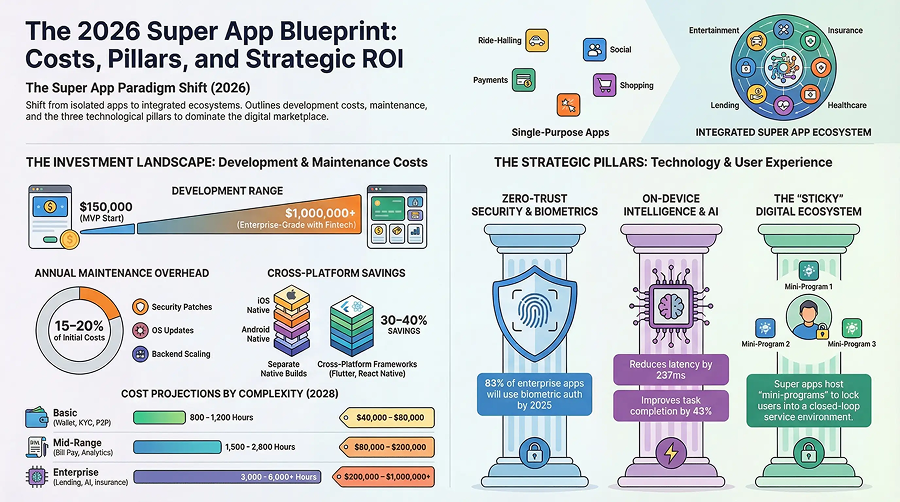
In the US market, the super app development cost usually starts at $150,000 for a Minimum Viable Product (MVP) and can easily exceed $500,000 to $1,000,000+ for a full-scale enterprise solution.
The high price tag is driven by the cost of labor in the United States and the sheer volume of features required. If you choose to hire dedicated mobile app developers within the US, hourly rates range from $120 to $250. This is why many firms partner with an enterprise mobile app development company offering a blend of local project management and global engineering talent to balance quality and budget.
Super app architecture for scalability
The backbone of any successful multi-service platform is its technical foundation. Unlike standard apps, Super Apps cannot be built as a single monolithic block; they would become too heavy and slow.
Micro-app architecture (The tech behind Super Apps)
The industry standard is now the Micro-App architecture (the technology behind Super Apps). This particular approach involves developing independent "Mini-Programs" that load dynamically within the main shell. This allows you to update the food delivery module without affecting the ride-hailing or chat modules.
- Cost Impact: Implementing this dynamic loading system adds at least $50,000+ to the initial backend budget.
Multi-tenant architecture as well as SSO
To handle multiple vendors as well as services well, you must implement a multi-tenant architecture. This ensures that data from "Vendor A" is isolated from "Vendor B." Furthermore, a Unified identity management (SSO) system is mandatory. This allows the user to log in once and move seamlessly from the chat interface to the payment wallet without re-authenticating.
Enterprise and AI App Development Cost and Maintenance Guide 2026
App Type or Complexity | Estimated Development Cost | Development Timeline | Key Features and Capabilities | Annual Maintenance Cost | Primary Cost Drivers | Target Platform or Framework |
|---|---|---|---|---|---|---|
Enterprise-Grade Super App Ecosystem | $250,000 – $1,500,000 | 8–18 months | Multi-modal AI, lending/BNPL, investment/trading, insurance marketplace, on-device AI, biometric authentication, cross-border remittance. | $50,000 – $300,000 | Compliance (GDPR, PCI-DSS, HIPAA), microservices architecture, enterprise-grade security (SOC 2), high-concurrency transaction engines. | Flutter, Kotlin, Swift, AWS/Cloud Infrastructure |
Mid-Level AI / Fintech Super App | $80,000 – $250,000 | 4–8 months | Predictive analytics, personalized recommendations, bill pay, budgeting tools, P2P transfers, digital identity. | $15,000 – $50,000 | AI complexity, custom model fine-tuning, backend architecture, third-party integrations (KYC/AML). | Flutter, React Native, Node.js, Python |
Basic AI App / MVP | $30,000 – $100,000 | 3–5 months | AI chatbot integration, simple automation tools, basic KYC, mobile wallet, standard templates. | $5,000 – $15,000 | Platform choice (iOS/Android), number of integrated APIs, and basic UI/UX design. | Flutter, React Native, iOS, Android |
Flutter Cross-Platform Solution (Standard) | $30,000 – $80,000 | 3–5 months | Single codebase for iOS/Android, custom design, user accounts, push notifications, and payment integration. | $3,000 – $15,000 | Platform coverage (mobile vs. web/desktop), UI/UX complexity, and developer region rates. | Flutter (iOS, Android, Web, Desktop) |
Key Technical Components and Cost Drivers
When you build a super app like WeChat/Uber, the complexity grows exponentially with every new service added.
1. The Development Team
You don't just need one team; you need specialized squads for each vertical. To ensure cross-platform efficiency, most US companies hire React Native developers or hire Flutter developers
- React Native: It is ideal for apps requiring high performance and a massive library of plugins.
- Flutter: Excellent for creating high-fidelity, brand-consistent UIs across iOS and Android with a single codebase.
2. Third-party API integration
A Super App will rarely design every service from scratch. Instead, it mainly relies on third-party API integration. For instance, if someone is looking to integrate the DoorDash API for logistics or the Twilio API for messaging. However, these kinds of integrations do require expensive custom middleware that can communicate correctly with your core system.
3. Financial Systems
Payment gateway integration (Stripe/PayPal) is the lifeblood of the app. Especially referring to the US market, these must be robust enough to easily handle split payments like paying the driver, at the restaurant, and the platform fee, simultaneously.
WeChat clone development cost in the USA
Many clients ask for a Gojek clone script cost or a WeChat clone development cost in the USA. While "clones" suggest a much cheaper shortcut, in the US market, a simple script is never enough.
- Off-the-shelf scripts: Can range from $10,000 to $30,000.
- US Market Adaptation: Customizing a clone to meet US consumer expectations, design standards, and legal requirements usually adds another $100,000+.
American users demand a high level of UI/UX polish that standard clone scripts simply do not provide.
Integrating third-party mini-apps
The true power of a Super App is its ability to let other businesses build within your ecosystem. This requires a "Mini-App Sandbox."
- Development Cost: Building the developer tools and documentation so third parties can integrate their services into your app is an advanced enterprise feature.
- Maintenance: You will need a dedicated team to review and approve these mini-apps to ensure they don't compromise your platform's performance.
Security challenges in super app development
As every well-designed Super App holds chat logs, GPS history, and credit card details, it is indeed a high-value target for several cyberattacks.
Data privacy compliance (CCPA/GDPR)
Operating in the US means you must adhere to strict Data privacy compliance (CCPA/GDPR). If you are targeting California residents, CCPA compliance is non-negotiable. This involves building data deletion protocols, "Do Not Sell My Info" toggles, and high-level encryption.
- Security Audits: Regular penetration testing as well as professional security audits can add $20,000 annually to your operating costs.
How to monetize a super app?
High super app development cost is justified by the massive revenue potential. A multi-service platform offers several streams:
- Commission Fees: Taking a certain percentage of each transaction, such as on a ride, a meal, or a product sold.
- Advertising: Selling "Featured" spots to vendors within the marketplace.
- Payment Processing: Charging a small convenience fee for using the integrated wallet.
- Data Insights: (While respecting privacy) Using aggregate data to offer personalized financial products or insurance.
Cost of maintaining a super app platform
Launch day is only the beginning. The cost of maintaining a super app platform is generally estimated at 20% of the initial development cost per year.
- Server Costs: High-traffic multi-service apps require scalable cloud infrastructure (AWS/Azure/Google Cloud).
- Bug Fixes: As iOS and Android update their operating systems, your app requires constant tweaking.
- Customer Support Systems: Managing a multi-vendor marketplace app means handling disputes between buyers and sellers, which requires an integrated CRM.
Summary of Costs (US Market Estimates)
Phase | Estimated Cost (USD) |
Discovery & UI/UX Design | $20,000 - $40,000 |
Core Backend & Micro-App Shell | $60,000 - $100,000 |
Service Verticals (3-4 services) | $100,000 - $250,000 |
Unified Identity Management (SSO) | $15,000 - $30,000 |
QA & Security Testing | $25,000 - $50,000 |
Total MVP Cost | $220,000 - $470,000 |
Conclusion: Is the Investment Worth It?
While the primary keyword, such as super app development cost, might seem to be daunting, the ability to capture the entire lifecycle of a consumer is the "Holy Grail" of modern business. By reducing friction and offering everything from payments to transport in one place, you build a level of user loyalty that single-service apps can never achieve.
To succeed well in the US, you need more than just a code. Specifically, there is a need for a strategic partner who understands Micro-app architecture (The tech behind Super Apps) and the complexities of the American regulatory environment.
Build Your Future with Netclues
Navigating the key complexities of Enterprise mobile app development company services requires a partner with a proven track record. So, if you need to hire React Native developers, Flutter developers, or a full-stack team to build a multi-vendor marketplace app, Netclues has the expertise to bring your vision to life. We specialize in high-scalability, secure Payment gateway integration (Stripe/PayPal), and seamless third-party API integration.
Contact Netclues Today for a Custom Super App Consultation
FAQ for the Cost to Build a Super App in the USA
Q. 1. How do enterprise super apps consolidate features and reduce costs?
A. Enterprise super apps bring multiple services, such as payments, messaging, shopping, and booking, into a single unified platform. Instead of building and maintaining separate apps, businesses share a common backend, authentication system, and infrastructure. This reduces duplication, lowers operational costs, and improves efficiency while delivering a seamless user experience.
Q. 2. Explain the 2026 cost differences between Flutter and native development.
A. In 2026, Flutter is generally more cost-effective because it uses a single codebase for both iOS and Android, reducing development time and team size. Native development, on the other hand, requires separate teams for each platform, which increases costs. However, native apps may still be preferred for high-performance or hardware-intensive applications where maximum optimization is critical.
Q. 3. How does Zero-Trust security impact enterprise mobile app performance?
A. Zero-Trust security ensures that every request, user, and device is continuously verified before access is granted. While this adds an extra layer of security, it can introduce slight delays if not optimized properly. Modern implementations use smart caching and adaptive authentication to maintain strong security without noticeably affecting performance.
Q. 4. How do on-device security measures improve app performance and speed?
A. On-device security processes data locally instead of sending it to remote servers. This reduces latency, speeds up authentication (like biometrics), and minimizes server load. As a result, users experience faster interactions, improved privacy, and smoother performance, even under low network conditions.
Q. 5. What are the common financial modules integrated into super apps?
A. Most super apps include a range of financial services such as digital wallets, peer-to-peer transfers, bill payments, subscription management, Buy Now Pay Later (BNPL), investment tools, and insurance services. These modules allow users to manage their finances without leaving the app, increasing engagement and revenue opportunities.
Q. 6. How much does it cost to maintain a complex app?
A. Maintaining a complex super app typically costs around 15% to 20% of the initial development cost each year. This includes server infrastructure, security updates, bug fixes, feature enhancements, compliance updates, and customer support systems. For enterprise apps, this can scale significantly depending on user traffic and integrations.
Q. 7. What is the fastest way to launch a super app?
A. Using pre-built white-label solutions is the fastest route, allowing a launch in 60-90 days, compared to over 9 months for custom builds.
Q. 8. How do I reduce super app development costs?
- Start with an MVP: launch only the most essential services (e.g., wallet and one additional service) and scale later.
- Use cross-platform development: Technologies like Flutter allow building for both iOS and Android simultaneously, saving up to 40%.
- Outsource to specialized teams: Utilizing firms in Eastern Europe or India reduces labor costs while maintaining high quality.
Q. 9. What are the key services in a US Super App?
A. A successful US super app generally includes high-frequency services such as:
- Fintech: Digital wallet, P2P payments, and banking services.
- On-Demand: Food delivery, ride-hailing, and grocery shopping.
- Logistics: Last-mile delivery.
- Communication: Secure messaging.
Q. 10. How does white-label differ from custom development?
A. White-label solutions are pre-built modules that are customized and branded for your business ($25k+), while custom development is built from scratch ($100k-$300k+).
Q. 11. Can I lower costs with a white-label solution?
A. Yes. White-label super app templates can reduce initial costs to $50,000 – $150,000 and cut launch timelines to 3–6 months.
Q. 12. What are the hidden costs?
A. Beyond development, budget for cloud hosting (AWS/Azure) at $500 – $5,000+/month, third-party API fees, and marketing (often 15%–30% of the total budget).
Q. 13. Why do most Super Apps start with payments?
A. A strong core service like payments builds high-frequency usage and user trust, making it easier to layer additional services like e-commerce or insurance later.
Q. 14. How much does it cost to build a super app?
A. The cost to build a super app typically ranges from $150,000 to $ 1,000,000 or more. A basic MVP may cost around $150K–$300K, while a full enterprise super app with multiple services, AI, and fintech features can exceed $1M, depending on complexity and scalability.
Q. 15. How much does it cost to develop an app in the USA?
A. App development in the USA usually costs between $50,000 and $400,000+. Simple apps start around $40K–$100K, while complex or enterprise apps with advanced features and integrations can go beyond $400K.
Q. 16. How much does it cost to build a service app?
A. A service app typically costs $80,000 to $350,000+, depending on features like real-time tracking, payment integration, and user management. More advanced apps with AI or multi-vendor support can cost significantly more.
Q. 17. How much does it cost to bring an app to market?
A. The total cost to bring an app to market ranges from $70,000 to $500,000+, including development, design, marketing, and launch. Ongoing maintenance adds an additional 15–20% annually to the development cost.