




Over the last few years, reliance on AI has shifted from a futuristic technology to a deep practice in the Canadian boardroom. It has become widely integrated into day-to-day operations. Be it more brilliant customer service, automation of repetitive tasks, or credible decision-making, leaders across Canada are under constant pressure to deliver something more valuable and sustainable with the help of AI, without ever compromising responsibility.
This is precisely where the right AI consulting partner comes into play. The greatest challenge in this regard is that just hiring a credible vendor doesn't meet the requirement. In 2026, the chosen AI partner must deeply understand Canadian regulations, data sovereignty concerns, industry-specific risks, and the honest expectations of your employees, customers, and regulators. Recent national data shows a sharp rise in organizations planning to employ AI in the next 12 months.
At the same time, there is significant growth in concerns about data sovereignty and AI governance, and even top Canadian executives consider sovereignty a non-negotiable requirement.
A harsh fact is that only a fraction of companies are following the AI ethics policies in place, creating a wide gap between intent and execution. This is precisely where the role of having the right AI consulting partner comes in.
Moreover, the chosen AI partner must have a clear understanding of the latest Canadian laws, industry-related risks, deep privacy expectations, and the Data Act AIDA, which literally guides responsible use of AI in the public sector.
The guide we are presenting here is specifically designed to make the entire work setup clearer and easier to understand. It will offer deep insights into the right way to evaluate AI consulting firms based on what actually matters, such as strategic fit, technical maturity, Canadian compliance, and long-term value.
It will provide you with a practical framework for selecting an AI partner with confidence, so your organization can grow without posing a risk to data, stakeholders, or market reputation.
Selecting the right partner is essential for success. To start your AI journey with local experts who understand the Canadian market, schedule a free AI strategy session with Netclues today.
Why do Canadian businesses need an AI consulting partner?
It won't be an exaggeration to say that AI use in Canada is growing at supersonic speed. Moreover, the segment of Canadian businesses planning to adopt AI within 12 months has risen significantly, a clear marker that AI can reshape a business's operations and competitiveness.
With a specific mention to the large-scale businesses, specifically those with 100+ employees, AI is mainly focused on the following:
- Data analytics and business intelligence.
- Text analytics and document processing.
- Virtual agents and chatbots for customer service.
The functions listed above are considered mission-critical. Any errors or hasty decisions can directly and significantly impact customer trust, revenue, and regulatory exposure. This is precisely why there is an immediate need to seek the best AI consulting support. Hence, AI consulting support is all about fostering resilience and reliability, auditability and transparency, and safe integration with existing controls and systems.
In financial services, AI is primarily used for functions such as pricing, underwriting, claims, and credit decisioning. In all these contexts, the key boards, audit committees, and regulators expect to have precise controls. So, a consulting partner must already be highly comfortable operating in such a high-risk kind of environment.
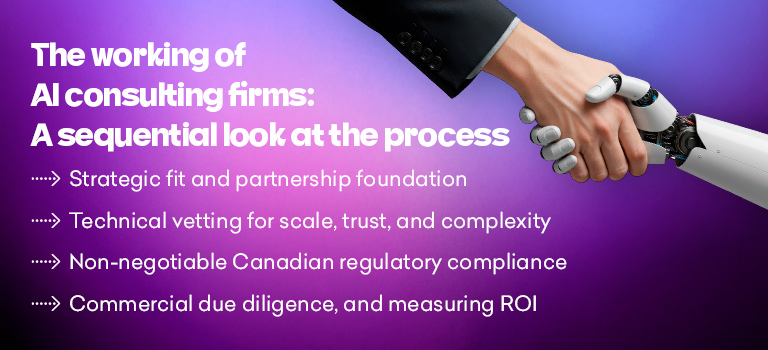
The working of AI consulting firms: A sequential look at the process
In general, there are four phases through which a mature AI consulting firm operates. Let us have a closer look at all of these four phases:
Phase 1: Strategic fit and partnership foundation
In this phase, the partner clarifies the precise business goals, risk appetite, priority use cases, and success metrics, and also gains clarity on how exactly artificial intelligence fits into a business's broader digital and data strategy. The prime focus here is on long-term capacity-building and not on mastering any one-off tools.
Phase 2: Technical vetting for scale, trust, and complexity
In this phase, assessment is conducted to determine whether the firm can build scalable core systems (MLOps, monitoring, and automation), is trustworthy (XAI, testing, and robustness), and is an ideal fit for your data reality (RAG vs. fine-tuning, data quality, and integration).
Phase 3: Non-negotiable Canadian regulatory compliance
It is imperative that the partner design and deliver AI that is compliant by default, meets PIPEDA requirements, specifically anticipates AIDA requirements, and also complies with provincial privacy regimes such as Quebec's Law 25.
Phase 4: Commercial due diligence, and measuring ROI
In this final stage, alignment is ensured on the total cost of ownership, which includes development, infrastructure, data, compliance, governance, and monitoring overhead, and a holistic ROI model that precisely accounts for financial and strategic value.
What is the Canadian AI consulting landscape?
Market structure and sector focus:
The Canadian AI ecosystem is known for a mix of large businesses rapidly scaling AI across analytics, automation, and customer experience. Next come the most regulated sectors, such as financial services, that are using AI in pricing, underwriting, and adjudication.
The third key segment is public sector and healthcare companies, where ethics, risk, and public trust are central to adoption. AI-based candidate assessment tools can perpetuate bias if they rely on unclear rules.
That's why partners must ensure scoring is transparent, easy to explain, and always backed by human judgment for final decisions.
In all these sectors and environments, consulting partners are expected to integrate AI into existing compliance structures and governance frameworks.
A closer look at the trends to watch in 2026
Data Sovereignty and Canada's "Sovereignty Crisis"
Canada's political and regulatory climate demands a particular approach to AI work. The central concern moving into 2026 is simple: who controls the data. Many leaders refer to this as a growing "sovereignty crisis."
About 72 percent of Canadian executives say data governance and compliance are their top AI challenges. This focus on jurisdiction is pushing teams to choose local deployment models and build region-aware AI frameworks that keep their data safe and compliant. It is equally important to understand the difference between storing data in Canada and having absolute sovereignty.
A Canadian data centre doesn't count if the parent company is headquartered abroad. When sensitive data relies entirely on foreign tech providers, organizations face greater exposure to foreign surveillance and fewer legal protections at home.
A strong consulting partner should be able to promise genuine Canadian control across the full AI lifecycle. That includes data processing, model training, and every operational touchpoint that must meet Canadian law.
National Investment and Innovation Hubs
Canada continues to back a robust tech ecosystem through its Pan-Canadian AI Strategy, which supports research and development across the country.
Most consulting partners draw talent and ideas from Canada's three major AI institutes:
- Amii in Edmonton
- Mila in Montréal
- Vector Institute in Toronto
These hubs help convert deep research into practical, real-world solutions. A partner connected to these centres is usually aligned with Canada's core innovation network.
The Governance and Ethics Gap
A significant risk for Canadian companies today is the wide gap between what they intend ethically and what they've actually implemented.
The Canada Workplace Trends 2026 report shows an apparent mismatch: while 46 percent of companies say ethical AI use is a priority, only 22 percent have a fundamental ethics policy in place.
This gap creates an opportunity for the right consulting partner. The partner must bring ready-made governance models and help clients embed an ethics framework into daily operations. This is how organizations build a culture of responsible AI.
And even though the Artificial Intelligence and Data Act (AIDA) had not become law by early 2025, it still sets the tone. It signals that companies using high-impact AI systems will face greater accountability and risk-management expectations.
Pro tips to choose the perfect AI consulting company in Canada:
- Prefer alignment with practical outcomes:
Canadian teams need more than advanced tech, and they are always looking for clear ways to measure value. Meaningful associations show how AI will save money, support teams, improve decision-making, and build long-term adoption. They don't just demand fast delivery, but actually help the organization build real strength so AI can run at scale.
- Industry exposure:
The right partner understands your sector and its risks. In finance, they must show how they explain complex model decisions. In HR, they must prove their tools are fair, transparent, and always backed by human judgment. Any partner who cannot show this should not be trusted.
- Strong change management and honest design:
AI works only when individuals begin to trust it. Also, a good partner teaches teams how to use AI well, keeps all disclosures clear, and avoids any misleading interface tricks. They help staff build confidence so that AI supports their decisions rather than replacing them.
- Mature MLOps:
A capable partner treats MLOps as an ongoing practice, maintaining clean project structures, tracking models, automating tests and deployments, and monitoring systems to ensure accuracy is never compromised.
- Explainability for trust:
AI decisions must be easy to check, explain, and audit. This is essential in regulated sectors. Without clear explanations, companies face higher legal and reputational risks. Explainability is now a basic requirement, not a bonus feature.
- True data sovereignty:
In Canada, data control is 100% non-negotiable. The partner must show that sensitive data stays in Canada and is protected under Canadian law. They must also understand PIPEDA, AIDA, and Quebec's rules, and build compliance into the system from day one.
- Transparent pricing and long-term worth:
The right partner is transparent about all costs, including hidden ones related to governance and monitoring. They help you see the full return over time, not just the quick wins.
Cost, ROI, and Risk: What Canadian Businesses Can Expect?
AI work in Canada comes with clear cost ranges.
- Consulting for strategy or planning usually runs between $100 and $450 per hour.
- If you need ongoing guidance, monthly retainers typically range from $5,000 to $25,000.
Project costs depend primarily on complexity:
- Simple tools like basic chatbots often cost between 8,000 and 80,000 CAD.
- Mid-level projects such as custom analytics or pipelines usually cost 40,000 to 200,000 CAD
- Large enterprises built with heavy security and deep integrations can cross 100,000 to 250,000 CAD
One high hidden cost is data cleanup, which can range from 10,000 to 90,000+ CAD, depending on the condition of the data.
Strong partners also flag compliance costs early. These often include:
- Legal reviews: 5,000 to 25,000 CAD
- Privacy assessments: 10,000 to 50,000 CAD
- Ongoing compliance checks: 2,000 to 10,000 CAD per month
Holistic ROI: Beyond the Balance Sheet
The actual value becomes evident when a partner brings strong governance, solid industry knowledge, and seamless system integration. When these pieces come together, organizations see better decisions, stronger customer trust, and broader adoption across the company.
Red flags to consider while picking a partner:
- No clear governance plan
- Weak or confusing data sovereignty guarantee
- Meagre understanding of PIPEDA, AIDA, or Law 25
- Treating MLOps as tools, and not long practice
- "Black box" decisions with no justified explainability
- No training or knowledge transfer
- Ignoring compliance and governance costs
How to Choose the Right Partner: A Simple Framework
- Set clear goals and risk limits: Decide what success means for your organization, both strategically and financially.
- Check the data and its readiness: assess your data quality, systems, and areas where MLOps needs to grow.
- Create a compliance-focused RFP: Bake in PIPEDA, AIDA, and Law 25 requirements from the start.
- Shortlist partners with real sector experience: Pick teams who understand your industry and have proven governance practices.
- Test their technical depth: Review their MLOps, explainability, and GenAI approaches.
- Test their governance and sovereignty claims: It is always recommended to enquire how they handle PIAs, data lineage, and accurate Canadian control.
- Fix costs with transparency: Ensure you include development, data prep, legal reviews, and ongoing monitoring.
How is AI in Canada taking shape?
Canada's future AI landscape will definitely be shaped by stronger privacy laws, rising sovereignty concerns, AIDA enforcement, continued national investment, and growing public demand for transparency and safety.
Partners will be judged not just on building models but on delivering safe, compliant, and Canadian-controlled AI.
Final Verdict!
Choosing an AI partner in Canada is indeed a strategic decision. The right partner blends technical skill with strong governance, deep knowledge of Canadian law, transparent pricing, and a commitment to long-term value. Where to start with AI? Find your ideal AI Partner in Canada by contacting Netclues experts. The experts will guide you with transparent, honest, and practical expertise tailored to Canadian organizations.
FAQ: How to Pick the Best AI Consulting Partner in Canada
1. Why do Canadian businesses need an AI consulting partner?
Canadian businesses need AI consulting partners to successfully adopt AI while complying with Canadian regulations like PIPEDA, AIDA, and provincial privacy laws. A good partner helps integrate AI solutions responsibly, ensures data sovereignty, and maximizes long-term value without risking customer trust or data security.
2. What should I look for in an AI consulting partner in Canada?
Look for an AI consulting partner with:
- Expertise in Canadian compliance laws (PIPEDA, AIDA, etc.)
- Proven experience in data sovereignty and governance
- Strong technical capabilities in building scalable AI systems
- Transparency in pricing and ROI metrics
- Industry-specific knowledge tailored to your business sector
3. What are the key phases in working with an AI consulting firm?
Working with an AI consulting firm typically follows four key phases:
- Strategic fit and partnership: Align AI solutions with your business goals.
- Technical vetting: Assess scalability, trustworthiness, and system integration.
- Canadian regulatory compliance: Ensure adherence to PIPEDA, AIDA, and other laws.
- Commercial due diligence: Measure ROI and assess total cost of ownership.
4. How does data sovereignty affect AI consulting in Canada?
Data sovereignty ensures that data is stored, processed, and managed under Canadian laws. For AI, this means choosing a consulting partner who can guarantee that your sensitive data remains protected from foreign surveillance and complies with Canadian data protection standards.
5. What trends will shape AI consulting in Canada by 2026?
Key trends to watch include:
- Data sovereignty will continue to be a top priority for businesses.
- Increasing demand for ethical AI solutions with strong governance frameworks.
- Tightening regulations, such as AIDA, require businesses to implement transparent and auditable AI systems.
- The rise of AI-powered automation across multiple sectors, from healthcare to financial services.
6. What are the costs involved in hiring an AI consulting partner in Canada?
The cost of hiring an AI consulting partner varies by project complexity:
- Strategy and planning: $100 - $450 per hour
- Small AI projects (e.g., chatbots): $8,000 - $80,000 CAD
- Mid-level projects (e.g., custom analytics): $40,000 - $200,000 CAD
- Large-scale projects (e.g., enterprise-level AI solutions): $100,000 - $250,000 CAD
- Additional costs may include compliance assessments and data cleanup, typically ranging from $5,000 to $90,000+ CAD.