




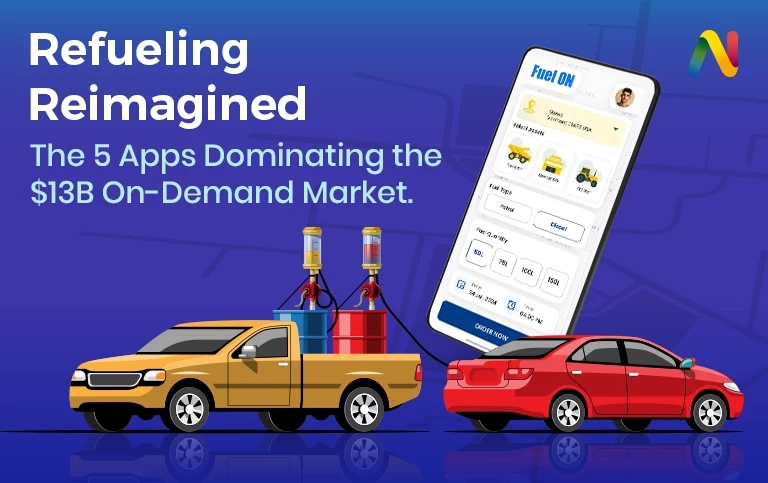
The fuel delivery market isn't a monopoly. It's split into three distinct battlegrounds: The On-Demand Consumer (EzFill), The Subscription Subscriber (Yoshi), and The Corporate Giant (Booster). Which model will you build in 2026?" This is the big question for any entrepreneur eyeing the next wave of on-demand fueling apps.
The good news? You don't need to invent a new concept; you need to pick the winning business model for your region. In fact, analysts predict the global mobile fuel delivery market will soar to $11.93 billion by 2030, indicating space for multiple winners.
To replicate these success stories, you need to hire mobile app developers who understand the specific logic of each model. As a top mobile app development company in the USA, we've studied these trends and outlined the playbook below.
Below is a quick feature comparison of the three leading US-based models (EzFill, Yoshi, Booster) as of 2026. Each column represents a distinct strategy, along with its "killer feature, tech trend, and a lesson for your start-up.
Comparison: EzFill vs. Yoshi vs. Booster (2026 Benchmark)
Feature / Model | EzFill (The Convenience King) | Yoshi (The Car Caretaker) | Booster (The Corporate Pro) |
Primary Target | Consumer & Small Biz (Residential, Boats, Florists) | Vehicle Owners (High-end car owners who want maintenance) | Enterprise Fleets (Amazon, FedEx, Corporate Office Parks) |
Revenue Model | Pay-Per-Delivery (Like Uber Eats for Gas) | Subscription ($20/month for "Club" membership) | B2B Contracts (Volume-based pricing + Data Fees) |
The "Killer" Feature | Micro-Location Pins: Users pin the exact parking spot in a crowded lot. | "Under the Hood" Services: They check the tires, oil, and wiper blades while you fuel. | "Smart Tankers": IoT trucks that auto-bill the corporate client with zero paperwork. |
2026 Tech Trend | Marine Logistics: Expanding into boat refueling (High margin). | Mobile EV Charging: Now offering mobile EV top-ups alongside gas. | AI Route Clustering: Fills 500 cars in one office park with zero driving between them. |
Lesson for You | Don't just target cars. Build a module for Boats & RVs to increase ticket size. | Don't just sell gas. Sell Time & Care via a subscription model. | Don't sell to individuals. Sell to Office Parks to guarantee 50 orders/day. |
1. EzFill – The "Uber for Gas" Model
How does it works?
EzFill is a pure on-demand fueling service. Customers use the app to order fuel at their vehicle's location, and a tanker comes to fill their tank, no gas station visit required. It's literally like ordering an Uber, but for fuel: "With just a few taps on the mobile app, you get the convenience of fuel delivered anytime, anywhere, whether it's for your personal car or a commercial vehicle”. This model fits the classic "I forgot to fill up" scenario perfectly. For example, a busy parent or commuter can request fuel at home or at work, and an EzFill driver will arrive shortly.
Why does it wins?
EzFill targets sheer convenience and volume. It serves multiple segments – individual consumers, small businesses, and even specialty markets like boating and florists. In fact, EzFill positions itself across "commercial, consumer, and specialty vehicles" – even delivering fuel to boats in marinas. By eliminating the need for station stops, EzFill saves users time and frustration. Also, the application's simplicity and broad appeal have driven explosive growth: by November 2022, EzFill's year-over-year revenue jumped from $1.86M to $4.09 M, alongside over 1 million gallons delivered nationwide. This rapid traction underscores the demand for hassle-free refueling.
Tech Highlight: Micro-Location Services
One amazing and unique feature is EzFill's precise location tracking. The particular app lets users drop a location pin exactly where their car is parked, and this works even when there is a packed parking lot. EzFill describes this as pinpointing the exact parking spot so technicians can find it quickly. This micro-location capability is crucial – imagine having to find one car in a 5,000-space lot. EzFill's ultimate success relies on advanced geolocation APIs that perfectly guide the driver to merely a few feet of where the vehicle is parked.
Context: Another impressive attribute is the context. Behind the scenes, EzFill's system precisely coordinates fuel requests with its driver fleet. Their mobile app and dispatch optimize which tanker goes where, ensuring fast turnaround. Because EzFill can serve so many segments (from home users to boat owners), it has positioned itself as "the only company to provide gas delivery in three vertical segments".
Takeaway: EzFill's model is ideal for startups focused on one city or region. If you want to capture volume quickly, a simple on-demand app like EzFill's is a great launch strategy.
Great for startups launching in a single city, it emphasizes building a rock-solid ordering and tracking app first, then scaling driver hiring and service areas. If you're going this route, think about which verticals to target (residential, marine, fleets, etc.) – the more vehicles you can serve, the more revenue you pull in.
2. Yoshi Mobility: The "Service-First" Model
How does it works?
Yoshi's model is more about following the principle of "set it and forget it" convenience. Instead of paying per drop, customers subscribe to a monthly plan (about $20/month) that covers unlimited fuel deliveries. Once enrolled, Yoshi members rarely think about gas stations again. They can schedule weekly or on-demand refuels for all their vehicles through the app or web portal. Unlike EzFill, Yoshi turns fueling into a membership club. The flat monthly fee creates predictability for both the user and the company.
Why does it wins?
The subscription model precisely creates a high Customer Lifetime Value (CLV). Members stay long-term because they pay each month, no matter how often they use it. As one industry report notes, "Yoshi offers a subscription-based model at $20 per month, ensuring unlimited fuel deliveries". In practice, users get so accustomed to the convenience and add-on perks that churn is very low. This recurring revenue stream means Yoshi can recover its development and operational costs much faster than a purely pay-per-use service.
Predictive Maintenance Alerts:
Yoshi has beautifully turned on-demand fueling into a comprehensive and automated car-care service. The app even tracks each vehicle's mileage as well as usage patterns. When an oil change or inspection is due, Yoshi doesn't just send a generic reminder; in fact, it proactively alerts the driver in advance. For example, the rider can receive a ping that their vehicle needs an oil change. This level of service is Yoshi's killer feature: it bundles fuel with vehicle maintenance (oil, tires, windshield wipers, etc.)
Context: Yoshi's UX encourages this bundled care. After each fueling, the driver might perform quick checks and offer add-ons. Members get regular updates on vehicle status via the app. Over time, this "under the hood" service creates loyalty: users trust Yoshi with more of their vehicle needs. (FYI: Yoshi has since expanded into EV charging and fleet services, but the 2026 model still revolves around a $20/mo car-care club).
Takeaway: Those looking for recurring revenue must build a robust subscription engine into their app. Moreover, modelling your app's feature set on Yoshi's approach, which is a combination of unlimited refuels + added services, further improves predictability. In discussions with developers, emphasize Subscription Management and member perks. Ask them, "Can we set this up like a membership club with auto-renewals, usage caps, and loyalty benefits?" That's how you replicate Yoshi's stickiness.
3. Booster Fuels: The "B2B Infrastructure" Model
How does it works?
Booster doesn't target individual consumers at all – it sells to businesses. Companies sign up for Booster to provide employees with free or subsidized fuel. Booster tankers park at corporate campuses or office parks during the workday, and employees leave their fuel doors open for service. Each driver's vehicle is linked to their employer, so fueling costs are billed on a monthly invoice. In short, Booster serves your boss, not you. The employee experience is frictionless: park and forget, and Booster handles the rest.
Why does it wins?
The magic of Booster is density and efficiency. One booster truck can service 50 cars in a single parking lot visit, with virtually no detours. That means far less driving per gallon delivered. As Booster's website explains, their AI routing engine greatly helps us pick the most fuel-efficient routes to fuel each customer, while balancing our resources. In practice, this clustering lets one truck loop through an office park and hit dozens of orders back-to-back. The result is zero wasted travel – every stop at work has dozens of payouts instead of just one.
Tech Highlight: "Kasparov" AI Routing:
Booster's edge is its proprietary AI. The engine, called Kasparov, takes in real-time data (traffic, weather, fuel demand, etc.) and finds the best fueling sequence. The reason why it is built after the chess grandmaster is that it walks through routes that help to minimize costs. For example, Kasparov might route a tanker so it can fill 50 cars in a parking lot without backtracking. This smart logistics reduces both travel time and fuel consumption for the tanker itself.
Takeaway: If you have connections to big businesses or office landlords, go the B2B way. This model requires securing contracts rather than individual downloads, but the rewards are enormous. Every order is prepaid via the employer. Your startup's sales strategy will involve business development and partnership building, so pitch your app as an enterprise solution. If possible, integrate APIs for corporate dashboards and invoices – these will be selling points for CFOs.
4. FuelBuddy (The IoT Leader) & Cafu (The Global Standard)
Fuel delivery isn't just a U.S. story. Two international pioneers show the global scope of the trend:
- FuelBuddy (India) – India's FuelBuddy has made transparency its mantra. They equip their tanker trucks with IoT-connected meters and sensors, so every customer sees exactly how much fuel is delivered. As their site boasts, they provide "the precise quality and quantity of diesel" with "industry's pioneers in IoT and cloud-enabled solutions" at Fuelbuddy. in. They even run a strict quality assurance program: Each fuel drop is checked for quality before it gets loaded. In a developing market where trust is crucial, FuelBuddy's smart meters and sensor data give customers confidence that the app and driver aren't cheating them.
Lesson: In new markets, build trust with technology and transparency (e.g., open data, receipts, tamper-proof meters).
- CAFU (UAE) – Dubai's CAFU is often called the "global standard" for fuel apps. It launched in 2018 and popularized mobile refueling in the Middle East. CAFU offers both on-demand and subscription options, plus a host of add-on services. Customers can get a car wash, battery replacement, or oil change alongside their fuel delivery. The platform is built for high density (petrol stations and marine fueling in Gulf ports) and even offers flexible service levels. One analysis notes: "CAFU also provides services like car washes, battery replacements, and oil changes. The platform offers both subscription and on-demand delivery models. In short, CAFU became a one-stop shop for vehicles.
Lesson: Emulate CAFU by bundling additional vehicle services and offering multi-model pricing (a mix of pay-per-use and membership). Also, note CAFU's focus on intelligent routing and pricing (they even experiment with dynamic fees in high-demand areas), which aligns with the AI trends seen in Booster and EzFill.
Together, FuelBuddy and CAFU show that mobile fueling is a global game. In every region, there's room to innovate – whether by leveraging IoT to build trust (India) or by scaling up efficient operations (Middle East).
How to Build Your Own Version in the year 2026?
After gaining deep clarity on the big players, here's a step-by-step blueprint to launch your own fuel delivery app:
Choose Your Niche
Decide whether you want the volume of an EzFill, the loyalty of a Yoshi, or the corporate focus of a Booster. Each model has different sales, marketing, and tech priorities. (EzFill's model needs a killer on-demand ordering app and lots of drivers. Yoshi's model requires a polished membership portal and service logistics. Booster's model needs robust fleet management and B2B integrations.) Your choice will shape everything else, from features to partnerships.
Build the Right Tech Stack :
- Consumer App: Use a cross-platform framework (React Native or Flutter) for the customer-facing app. This speeds development and ensures iOS/Android availability.
- Driver App: Build natively for Android, since most fuel truck tablets run Android OS. Hiring Android developers in the USA (or your region) can help here, as they often have experience integrating with automotive telematics hardware.
- Backend/AI ("The Brain"): Develop a robust server-side system using Node.js or Python. This will handle order dispatch, routing (AI/ML engines like Kasparov), and integrations. The brains of your platform will coordinate deliveries in real time.
(You should also plan the admin dashboard, payment gateways, and mapping APIs at this stage.)
Estimate the Costs :
The price depends largely on the complexity. Based on industry surveys, a basic fuel delivery app (customer and driver apps with core features) can be built for roughly $40,000–$ 80,000 in 3-6 months. A medium-complexity version with subscriptions, fleet management, and advanced routing might cost $80,000–$125,000 at appinventiv.com over 6-9 months. Here's a simplified breakdown:
- Simple Clone (like a basic EzFill or Booster MVP): ~$40k–$60k.
- Complete AI-Powered Fleet Platform: ~$80k–$120k or more.
Conclusion
Whether you want to follow Yoshi's subscription model or EzFill's on-demand approach, it's essential to hire mobile app developers who've worked with systems similar to yours. If you're looking for a team that understands the challenges and the opportunities, we're here when you're ready.
Global Cost Comparison: Hiring Developers in the USA vs. the UK vs. India
One of the biggest budget factors is where you hire developers. A 2026-ready fuel app's cost can swing by over 60% depending on location.
Below is a breakdown of the cost and strategic advantages when you look for a mobile application developer in the USA, UK, or India.
Hourly Rate & Total Cost Breakdown (2026 Estimates)
Region | Avg. Hourly Rate | MVP Cost (Est.) | Strategic Advantage |
USA | $120 - $180 / hr | $90,000+ | Best for strict compliance (Hazmat/DOT) & same timezone collaboration. |
UK | $80 - $120 / hr | $60,000+ | Ideal for Fintech integration (Open Banking) & GDPR expertise. |
India | $25 - $50 / hr | $30,000+ | Cost-efficiency, 24/7 development cycles, and rapid scaling. |
Why Hire Mobile App Developers in the USA?
If your primary market is North America with complex regulations (fuel is hazardous after all), going local can pay off. When you hire mobile app developers in the USA, consider that you're buying regulatory confidence. U.S. developers are well-versed with DOT hazmat rules, state transportation laws, and also the data privacy requirements. You also get time zone alignment for agile sprints and often niche expertise. For instance, it's easier to find developers in the USA with experience integrating vehicle telematics or American fleet hardware.
Pro Tip: Many enterprises use a hybrid approach: hire a U.S.-based project manager for communication and legal oversight, while coding is done offshore to save costs.
Why Hire Mobile App Developers in the UK?
London is indeed a global fintech hub. If your fuel app has advanced billing, subscription payments, or European expansion plans, then a credible UK mobile app development company offers unique strengths.
UK dev teams excel at secure payment integrations (think Open Banking APIs) and GDPR/PECR compliance by default. Hiring mobile app developers in the UK ensures your app handles EU/UK data rules out of the box.
They're also well-versed in consumer Fintech features like recurring billing, making them ideal for a Yoshi-style subscription model.
Why Hire Mobile App Developers in India?
For startups on a budget, India is the ROI king. The same feature set you'd pay $90k+ for in the West can often be built in India for $30k–$ 40k (aptunix.com). Massive cost savings mean you can allocate more budget to marketing or expanding features. Plus, Indian teams allow 24/7 development cycles (you get work done overnight) and rapid scaling (it's easier to grow an Indian dev team from 5 to 50 people). As Apptunix notes, India-based fuel app teams can deliver quality equal to U.S. teams at far lower rates.
The Final Verdict:
You don't always have to pick one location. The most innovative companies in 2026 use a global delivery model. For instance, hire a mobile application developer in the USA as your project lead (for communication and compliance) and build the bulk of your engineering team in India for cost-effectiveness. This way you get the best of both worlds: U.S./UK-based project management for clear communication and legal compliance, and India-based engineering for rapid, affordable execution.
Ready to Start?
Whether you need to hire Android developers in the USA for onsite testing and performance, or build a cost-effective team in India to hit your budget, flexible engagement models are available. The code is the foundation of your business, so hire mobile app developers who have analyzed these industry giants and know how to help you beat them.
FAQ – Fuel Delivery Apps 2026
Q.1. What are the best fuel delivery apps in 2026?
A. The top apps right now are EzFill, Yoshi, and Booster. Each one has a unique style: EzFill is perfect for quick on-demand refueling, Yoshi focuses on subscriptions with extra car care, and Booster works best for businesses with fleets.
Q.2. How does EzFill’s on-demand fuel delivery work?
A. EzFill makes fueling as easy as ordering food. You just pin your car’s exact location in the app, and a driver brings the fuel right to you. It’s simple, fast, and you pay per delivery.
Q.3. Why is Yoshi’s subscription model so popular?
A. Yoshi isn’t just about fuel—it’s about peace of mind. For $20/month, you get unlimited deliveries plus vehicle check-ups like oil, tires, and wipers. Customers love the convenience and tend to stick around for the long term.
Q.4. How does Booster help corporate clients?
A. Booster focuses on efficiency. One tanker can fuel dozens of cars at an office park in a single trip, using AI to plan the fastest routes. Billing happens automatically through the company, so employees don’t worry about a thing.
Q.5. What tech features should a modern fuel delivery app have?
A. A successful app should include real-time GPS tracking, AI-powered route planning, subscription management, fleet dashboards, secure payments, and, optionally IoT sensors to track fuel delivery accurately.
Q.6. How much does it cost to build a fuel delivery app?
It depends on the complexity:
- Basic MVP: $40k–$60k
- Medium platform (subscriptions, AI routing): $80k–$125k
- Enterprise AI-powered fleet system: $120k+
Q.7. Where should I hire developers for my app?
- USA: Great for regulatory compliance and timezone alignment.
- UK: Excellent for GDPR and advanced billing systems.
- India: Cost-effective, fast development, and scalable teams.
Q.8. Should I choose on-demand, subscription, or B2B for my app?
- EzFill (on-demand): Great for city launches with lots of consumer orders.
- Yoshi (subscription): Perfect for building recurring revenue and customer loyalty.
- Booster (B2B): Ideal if you want to work with office fleets and guarantee daily orders.
Q.9. Can I mix different models in one app?
A. Absolutely. Apps like CAFU combine on-demand fueling with subscriptions and extra services, giving customers more choices and boosting your revenue potential.
Q.10. How do I stay compliant when launching a fuel app?
A. Work with developers who understand hazmat rules, fleet safety, and data privacy in your region. Local experts help keep your app legal, safe, and trusted by users.