




The mobile application economy is definitely in its booming stage, and it is forecasted to exceed $1 trillion by 2034. A whopping 5.78 billion mobile phone users are present worldwide as of 2025, representing 70.5% of the world's total population. Most consumers now use mobile devices as their primary means of accessing the internet. In this landscape, it is indeed the need of the hour for CTOs to hire mobile app developers with the right expertise. Hiring can be done in-house or outsourced, as convenient and preferred. Another important consideration for a CTO is not only who to hire, but also the big question of when to hire mobile app developers, which demands equal attention. Today, many startups commonly outsource mobile app development to specialized agencies rather than build in-house teams. Also, some CTOs feel it is highly efficient to partner with a full-service mobile app development company that offers tailored end-to-end services, covering every aspect from design to deployment.
Outsourcing is now widespread, and more than 70% of tech firms prefer outsourcing at least part of their development work. The ultimate key here is to balance quality, speed, and cost.
This playbook is your detailed guide to hiring expert mobile app developers in 2026. We will cover the context, key skills to look for across the key hiring models, top regions to target, tech stacks to include, cross-platform development, developer evaluation, legal tips, collaboration tools, best onboarding practices, and a summary of all.
Netclues is indeed a proven partner, making it easier for CTOs to transform app ideas into high-performing products.
The CTO's Playbook: Strategic Steps for 2026
Key skills and role of mobile teams:
Building a high-performing app is not possible without a strong, dedicated team. Always remember that when you hire mobile app developers, you must look beyond the coder profile. A great team must include experienced UI/UX designers, QA testers, front-end and backend engineers, and product managers. Many credible mobile application development service firms emphasize expertise in both cross-platform and native stacks. Other highly-demanded skills in this profile include automated testing, cloud backends, and RESTful API integration. In addition, the soft skills of agile collaboration and straightforward communication matter, especially when building a remote development team across varied time zones.
Beyond the Resume: Vetting for 2026 Skills
Even after being confident in the decision to outsource mobile app development, it still needs proper execution to deliver significant returns. Hence, picking the right partner is of utmost importance. Gaining clarity on how to choose an app development partner identifies explicitly the key parameters to consider and the sequential steps to follow to reach the right partner.
Let us understand the key procedure to make the perfect selection:
- Perform a thorough check on expertise and tech stack:
Every business has unique requirements for mobile app development. Hence, it is essential that you first confirm your prospective partner has relevant experience in the core technologies you specifically need. Therefore, it makes sense to hunt for portfolios representing apps similar to your requirements.
- Review detailed portfolio and references:
One of the basic steps is to review the available portfolio and cross-check it with the given references to assess the work quality. If a resource is legitimate, it would have a public portfolio and positive customer testimonials on credible platforms such as Clutch and GoodFirms.
- Deeply assess the culture and communication fit:
Ensuring clarity in processes is extremely important. Make sure that you verify each location listed on the company website, along with the listed contact details. Confirming the contact details ensures genuineness and transparency. One important consideration here is time-zone overlap and language fluency. The point is essential when teaming up with offshore app developers.
- Enquire about methodology:
You must gather precise details about the development process, which comprises agile ceremonies, testing practices, and specific project management tools. Note that the most credible partners will share a straightforward workflow covering all steps from discovery to deployment.
- Build a relationship between cost and value:
Never commit the blunder of simply running after price, and always aim to strike a balance between cost and value. Do not hesitate to pay a slightly higher rate if you are hiring a reputable mobile app development company. It will deliver better returns on investment, too, with unmatched quality, robust coding, and dedicated support.
- Ask for a trial project:
One of the most credible ways to fetch a trustworthy bid is to consider a paid trial task or a coding evaluation. It proves to be a great way to evaluate external developers. The trial assessment would be a great way to test problem-solving and collaboration skills.
The ultimate key is to identify partners who have exceeded core skills and expertise and have also mastered detailed business understanding, adaptive operational processes, and hybrid team management. The partners who have successfully evolved holistically, which is beyond the scope of their industry, can prove to be genuine resources in the long run.

The Legal Fortress: Protecting IP & Data
This is indeed one of the most crucial aspects while hiring a mobile app developer. Protecting your intellectual data property and sensitive data should always be the top-most priority.
Listed below are the top agreements that must be formalized for a safe and long-term association:
- Non-Disclosure Agreement (NDA):
Before you take the significant step of sharing any proprietary details, you must have the selected developers or firms sign a professionally drafted NDA. An NDA must always be the first document in any app development partnership to protect against data theft or misconduct.
- IP Assignment:
The contract to be signed with the hired professional or agency must clearly state that all code, as well as any IP developed by the association, will belong solely to the company. This level of clarity from the very beginning eliminates the risk of future ownership disputes.
- Compliance:
If you are seeking development support for an application that will handle personal data, you must ensure that the chosen developers comply with regulations such as GDPR/CCPA. Also, it is crucial to include data protection clauses to provide a safe association.
- Payment Terms:
It is a great trick to always link the payment schedule to key deliverables or pre-defined milestones. A clear definition of payment terms will help keep development on schedule and within scope.
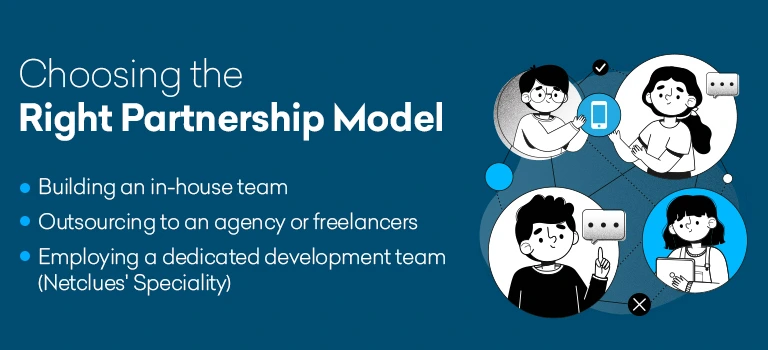
Choosing the Right Partnership Model
CTOs are blessed with diverse models, and they can make the best selection for a project's needs. One scenario could be hiring mobile app developers as full-time employees (in-house setup) or engaging an external firm. In fact, startup-level firms even choose to employ a remote development team right from day one. The step is considered beneficial as it eliminates office overhead costs.
Let us have a closer look at all these models for better decision-making:
- Building an in-house team:
If you decide to hire professional mobile app developers as permanent staff, you would recruit local developers and build an internal app team.
Pros: It provides direct oversight and complete IP control.
Cons: This alternative can prove costlier and might end up in long recruiting cycles.
Outsourcing to an agency or freelancers:
The second alternative, in hand with a CTO, is to engage a dedicated mobile app development company or employ external app developers on a freelance basis.
Pros: Provides broader skill access, allows rapid ramp-up, and often offers a predictable pricing structure. Also, there is immense scope for cost savings and faster market time here.
It provides direct oversight with full IP control.
Cons: There is less direct control, which can lead to communication overhead and may pose IP risks.
Employing a dedicated development team (Netclues' Speciality):
Another hiring alternative is to seek support from a dedicated development team from a credible agency. The work setting here includes effective outsourcing with fixed full-time resources. The biggest reason for CTOs to pick this route is that it provides consistency, with control, and the flexibility of remote staffing.
Pros: It allows full-time focus on a specific project, offers better control, and is scalable and cost-efficient.
Cons: It definitely needs active management; there is a high risk of time zone gaps, which can lead to communication issues, and long-term commitment might limit flexibility.
Remote development team:
This hiring system works by entering into a contract with a firm that offers you a remote team.
Pros: Provides instant, no-stress access to global-level talent without incurring any overhead costs.
Cons: Can only work with a strong communication process.
Contract App Development:
The contract app development includes hiring agencies on a time-bound contract. The setup is especially beneficial for short-term projects or those that need specialized expertise.
Pros: Highly cost-efficient and flexible, offers quick access to specialised level skills, and is best for prototype projects.
Cons: Offers limited consistency after project completion, and is linked with less commitment.
In addition to the above-mentioned hiring systems, CTOs sometimes choose to outsource mobile app development for specific components of an app if they feel their in-house professionals are incompetent. For instance, the hybrid approach involves outsourcing Android mobile app development while the internal team focuses on iOS. Moreover, whatever the final selection is, it need not be rigid. The companies can continually reassess their requirements, whether to grow their internal staff or continue outsourcing mobile app development. Ultimately, the final decision to outsource mobile app development is based on key factors, namely timelines, budgets, and required expertise. According to a 2025 survey, nearly 42% of firms choose to outsource to gain access to specialized talent, while the remaining 34% aim to optimize costs.
An explicit mention of the top benefits of outsourcing mobile app development:
Especially for CTOs, it is highly relevant to gain clarity on the benefits of outsourcing mobile app development. Here is a clear listing of the prime rewards that CTOs can expect from making this decision:
- Better cost saving:
One of the most significant advantages of outsourcing is a whopping 60 percent reduction in operational costs.
- Gives access to global talent:
Outsourcing is the golden route to skilled developers versed in the latest frameworks, namely AR/VR, React Native, and Flutter.
- Faster outcome with excellent scalability:
It is observed that external teams scale quickly. It is reported that outsourced projects experience up to 25% faster product launches than in-house projects.
- Promotes focus on core business:
As the best external experts handle the app development deliverables, the in-house team can better focus on strategic goals and core features.
Being aware of the key benefits of outsourcing mobile app development helps you decide whether an external partnership aligns well with your strategy.
Link Suggestion: "The Real Cost of Offshore Development: Hidden Fees and Budgeting Tips"
What are the top offshore destinations?
It is evident that a vast pool of talent surrounds us; it is indeed a blessing that CTOs today have this choice, allowing them to seek the best support for cost-effectiveness and long-term success. Offshore app developers from regions, namely India, Eastern Europe, Southeast Asia, and Latin America, are in high demand. These specific regions offer a vast number of skilled and experienced engineers at competitive rates. Overall, India clearly tops the list owing to its millions of developers. In fact, it is estimated that India's skilled developer population would exceed 57.5 million by 2030.
Considering other essential aspects of team building, such as time zones and culture, nearshore alternatives like Latin America for U.S. companies and Europe for EU companies can help address lag. In fact, there is no dearth of companies hiring remote development teams that combine local management with the best offshore talent. Given the significant percentage of developers working fully remote, it is clear that this work setup would not fail. So, whether you choose to build an in-house team or have made up your mind to rely on a fully remote development team, establishing clear communication is paramount.
Spotlight on major technology stacks and trends:
There's no single tech stack that applies to every project requirement. The right tools depend on what your app needs to do, how fast you want to go to market, and how much flexibility you need later on.
Native iOS/Android:
If you're building something that relies heavily on device hardware, such as AR, cameras, sensors, or Bluetooth, then go with this alternative. Swift is the go-to for iOS; Kotlin (or Java) for Android. Native development gives you full access to everything the device offers and generally delivers the best performance.
Cross-Platform Development:
Aiming to launch on iOS and Android at the same time without building two separate apps? Frameworks like React Native, Flutter, and Xamarin let you write once and deploy to both. It's faster, easier to maintain, and an excellent choice for most business apps. Ensure that your team knows their way around cross-platform development; done right, it can save a lot of time.
Backend and APIs:
It is a fact that almost every app needs a backend, whether it's for user login, content storage, or real-time features. Popular choices include Node.js, Django (Python), and Spring Boot (Java). Many teams also go serverless with Firebase or AWS Lambda. Hence, the developer must know how to connect everything smoothly and scale it when traffic grows.
Emerging Tech: AI, AR, and VR
If your app relies on AI to personalise content or on AR to create immersive experiences, ensure your developers have real-world experience. Toolkits like ARKit (iOS) and ARCore (Android) are great, but only in the right hands.
CI/CD and DevOps:
Releasing updates manually is a complicated and time-consuming task. An expert team sets up pipelines using tools like GitHub Actions, Jenkins, or Fastlane. Add automated testing to the mix, and you get faster, cleaner deployments and fewer late-night bug fixes.
Once the tech stack is sorted, the next big thing is to evaluate and hire developers rightly:
Whenever you are interviewing the chosen candidates or agencies, it is essential that you combine technical assessments with a practical evaluation:
Portfolio scan and code tests:
It is always a great idea to ask the developers to share their best and diverse code samples. Here, GitHub repos will also work. The best coding platforms, such as Codility or HackerRank, should be used only for skill testing.
Give sample tasks:
There are specific projects for which it is crucial to verify the applicant's technical expertise. Here, it is recommended that you rely on paid mini-projects. The submission would serve as a clear blueprint for several essential parameters, including creativity, coding style, and adherence to given specifications. This way, you would significantly reduce the risk of delegating the main project to a naïve developer.
Deep study of past projects:
Always take the candidature of developers who already have a credible amount of experience building apps similar to yours forward. To be even more sure of the authenticity, request valid proof of certification from credible bodies such as Google's Android Associate and AWS Certified Developer.
Soft skill assessment:
Communication is the real backbone of any successful project, especially when the deliverables are expected from a remote development team. Hence, it is non-negotiable to ensure that the chosen partner has expertise in clearly explaining their previous work and can collaborate effectively to meet the project's requirements.
Cultural Fit:
Communication and work ethics would take shape only when the cultural fit is appropriate. Hence, you need to ensure that the chosen developers align with your team's values and the workflow you follow. Some of the core team values include accountability and self-management.
Mastering Remote Project Management
There is a strong need for practical collaboration tools to keep all parties working on your project in sync and avoid miscommunication. Here are the top collaboration tools that you can rely on:
Communication:
The best tools for communication are Slack or Teams for chat support. If video calls are needed, Zoom and Meet are easily accessible.
Project Management:
Jira or Trello are leading platforms for managing tasks and sprints. The key advantage of these tools is that they allow the entire team (both on-site and remote development teams) to see the exact status and priorities of each piece of work.
Source Control:
GitHub or Bitbucket is best for code. It is further recommended to enforce code reviews and CI pipelines to maintain the performance quality.
Documents and Designing:
Here, Figma or Adobe XD is ideal for UI mocks, and Confluence or Notion is ideal for specs.
Integration:
For automatic updates, there are credible link tools like Slack-Jira integration. You can use shared drives such as Dropbox and Google Drive to store your assets.
Meetings:
It is essential to make effective use of overlapping hours, especially when managing international teams. Relying on regular stand-ups, sprint planning, and demos helps to keep everyone aligned across varied locations.
Before delegating any task, the first step is to set up all the channels and accounts. Design document protocols for branching, code merges, and issue tracking so that in-house and outsourced developers are on the same page and there is no confusion at any point.
Final onboarding and team building:
Once all setups and processes are complete, the onboarding process brings professionals to work. Proper onboarding helps the newest members feel confident and welcome.
Key steps involved in onboarding:
- Kickoff Meeting:
Here, you need to align with the new members on key goals, scope of work, and the precise timeline. This is the stage where you introduce each member's roles and tools.
- Detailed Documentation:
Share up-to-date specs, design mocks, and coding guidelines. The best tools to employ here are a shared drive or a wiki.
- Environmental Setup:
The environmental setup in the onboarding procedure signals provision of access to code repos, servers, and databases. You need to take the new hires on a walkthrough of the whole development environment.
- Trial Tasks:
You can begin by assigning a simple ticket to help new members become familiar with the codebase and workflow.
- Regular check-ins:
Do not leave everything to the developer or the agency, even if they bring tremendous experience. Make it a point to schedule frequent progress reviews. The person leading must give a detailed demo and then proceed to develop the following tasks.
- Feedback Loop:
Keep an open environment wherein questions and retrospectives are encouraged. Openness is essential for welcoming process improvements at times.
The onboarding steps discussed above are equally helpful for managing an in-house team, fostering consistency, and top-notch performance. Especially with a remote development team, regular communication is a must for greater clarity and reduced risk of errors or delays.
Final Verdict!
Hiring the best and most dependable experts in 2026 indeed demands following a strategic approach. So, whether you choose to hire mobile app developers in-house, build a dedicated team, or decide to outsource mobile app development via a contract or agency, aim to focus on matching skills to project needs. Clearly defined roles and the proper use of credible collaboration tools define the ultimate route to success. By partnering with a reputable and dedicated mobile app development company that offers holistic services, you can turn your app idea into reality without compromising speed or quality.
Why partner with Netclues to hire expert mobile app developers?
Here at Netclues, we promise to deliver top-end mobile app development services tailored to align perfectly with your business goals, serving clients across the USA, Canada, the UK, and Australia. We are the best support to guide you through a structured process: once you post your requirements, our team of analysts will reach out for a free consultation, and then you can choose an engagement model before development begins. The four-step model we practice comprises requirement sharing, consultation, model selection, and execution, ensuring clarity at every step.