



In today's fast-changing tech job landscape, speed is everything. In fact, companies are now shortening hiring cycles by embracing AI-powered tools and hiring for new roles, such as "vibe coding" developers, whose main task is to code while guiding AI agents.
It is reported that 70% of companies now rely on automated screening to reduce hiring time dramatically. In fact, global brands like McDonald's have slashed the time required to hire hourly workers from a good two weeks to merely a day or two with the help of AI bots.
By combining these latest trends, we can help you hire vibe coding developers in 48 hours. The process will be entirely streamlined and AI-driven. Simply put, hiring "vibe coders" (AI-augmented developers) is actually possible on a hyper-accelerated timeline.
It is the best realization that hiring vibe coding developers in 48 hours is achievable through an AI-augmented workflow that prioritizes functions such as prompt engineering, live AI pair programming, and focused skill assessment. Intelligent automation is used to identify and pre-screen suitable candidates; the evaluation is then conducted using their AI tools.
The approach is fantastic, and it literally compresses an entire month-long process into a mere two-day affair with no compromise on value. Hence, by leveraging AI at every step, our well-structured, smart 4-step process can secure, screen, interview, and even extend offers to top AI-fluent talent in only 48 hours.
Let us now break down the four-step hiring process that can make this dream target a reality.
It is commendable that every step is carefully designed to be extremely efficient and scalable.
The sequential steps that would be discussed include the following:
- Automated AI sourcing and screening
- Skill Assessment and "vibe check"
- Live "Vibe Coding" session interview, and finally,
- Rapid decision and offer extension
By the end of this informative guide, you will know exactly how Netclue's 48-hour process for hiring AI-assisted programmers works in practice. Also, it will greatly empower you to assemble a team of accelerated software development talent.
Raising curtains on who a "Vibe Coding" Developer is
In simple terms, a "vibe coding" developer is a kind of software engineer who is responsible for guiding AI tools to generate the desired code, rather than manually writing every line. According to IBM, "vibe coding" refers to "prompting AI tools to generate code rather than writing code manually."
Hence, it is evident that with this technology, the hassle of typing detailed code is eliminated. The coder simply needs to elaborate on the expected outcome in simple language, leaving the technical details to the AI assistant to handle and implement.
In Google Cloud terms, the process is called shifting from writing code line by line to guiding an AI to "generate, refine, and debug" an application through a conversational workflow.
Hence, it is clear that traditional programming is manual and more detail-oriented, whereas vibe coding is more intent-driven and results from close collaboration with artificial intelligence.
Also, as per Google's comparison chart, traditional coding requires "higher" raw syntax expertise, while vibe coding, on the other hand, requires an understanding of "the desired functionality" to act as an AI's guide, tester, and even refiner.
Raising curtains from the difference between vibe programming and traditional programming?
- Nature of work:
One of the most relevant and direct differences between traditional programming and vibe programming is that traditional developers write most of the code themselves, while paying close attention to syntax and implementation details. Vibe coders, on the other hand, describe the end goal, such as "build a user login API", and then leave the AI technology to handle the underlying code.
- Speed of work:
As per Google notes, traditional coding is slower and more methodological, whereas vibe coding can be faster, especially for prototyping. One point to consider is that the significant speed difference will be noticeable only if the developer rigorously tests and refines the AI's work. Even the vibe coders need impeccable testing practices, a strong architectural sense, and credible quality control to ensure the AI output is accurate.
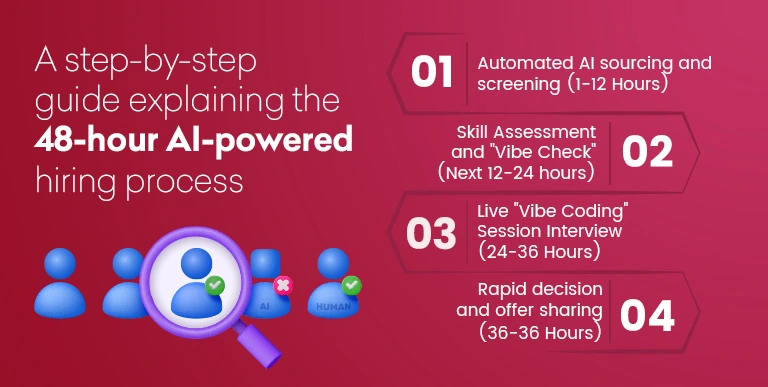
A step-by-step guide explaining the 48-hour AI-powered hiring process:
Step 1: Automated AI sourcing and screening (1-12 Hours)
The initial step is to make use of AI-driven talent sourcing. Here, the use of modern and advanced recruiting platforms is done for scanning public profiles as well as developer communities by entering relevant key terms such as "prompt engineer", "AI pair programming," and "cursor," etc.
For example, relying on the most trusted AI sourcing tools, such as hireEZ, can help retrieve candidate data from more than 45 platforms, including LinkedIn, GitHub, etc. Further AI filters help to surface the best matches available.
In addition, using tools such as Paradox can crawl LinkedIn and similar platforms to find matching skills and leverage conversational AI to even shortlist candidates. Automated solutions are making a significant contribution to reducing manual labor, and AI recruitment tools are helping recruiters spend much less time on repetitive tasks such as resume screening.
After the initial screening is completed with AI tools, the next candidates are filtered based on their portfolios and experience with rapid development projects.
The final stage involves administration through a brief AI coding challenge. Here, a problem is designed to test how well the applicant can interact with an AI assistant.
This kind of evaluation might require the applicant to solve a minor task by using an AI tool of their choice. The sole objective here is to let the applicant demonstrate how they can prompt and even refine the AI-generated code.
Step 2: Skill Assessment and "Vibe Check" (Next 12-24 hours)
The next step is to assess the fit between the communication and workflow. Here, short, asynchronous video interviews are conducted in which the candidates are asked to discuss their AI development experience, showcase their collaborative style, and demonstrate how they handle common AI errors.
For instance, these interviews might question "How do you ensure that an AI-generated function is absolutely correct and trustworthy?" or "Describe your AI coding workflow in detail." Further, the AI-enabled analysis of these interviews is used for further processing.
Next, the video responses are transcribed and analysed for extracting insights, specifically on clarity and fit. It has been proven that AI interviewing tools can evaluate candidates' spoken responses in real time, flagging key traits such as qualifications, personality, and even cultural fit from their answers. Also, other tools listen, take notes, and even transcribe the conversation, so the focus can shift purely to the candidate's content.
By the end of this step, one gets detailed objective data on communication skills and company fit, key aspects of quality hiring. The whole exercise supports confirming that the technical talent aligns with modern engineering hiring practices and that the chosen candidates will work well within the team's culture.
Step 3: Live "Vibe Coding" Session Interview (24-36 Hours)
This particular step can be considered the core of the entire hiring process. Here, a live shared-screen coding interview is scheduled, and the candidate is made to perform actual "vibe coding".
In this stage, the candidate is given a clear problem, such as building a basic API endpoint with complete user authentication. Hence, the candidate uses a preferred AI coding tool to implement the generated solution while explaining the entire thought process.
The role of the interviewer here is to closely monitor the candidates as they craft prompts, integrate AI output, debug errors, and further refine the code when required. In simple terms, this is a pair-programming session powered entirely by AI.
Incruiter defines the entire setup as a "live collaborative coding environment" used to closely assess applicants' practical skills in real time. Other important parameters assessed here include the applicant's coding quality, efficiency, and adherence to best practices.
The prime focus is on core engineering instincts, like how well the candidate tested the code. Did they perform all necessary error checks while documenting everything, and were they able to make sound architectural choices? Here, even automated code analysis tools can be employed to offer features such as "real-time code analysis," enabling closer evaluation of code style and performance to further speed up the hiring process.
Step 4: Rapid decision and offer sharing (36-36 Hours)
The final step is all about reviewing and making the final offer. Immediately after the live interview, the decision-makers review the recording and provide feedback based on their expertise and key expectations for the profile.
Hiring expert Josh Bersin also notes that "if you don't get somebody through the process fast, you're going to lose them." Having this clarity in mind, the final offer is extended within 48 hours.
The ultimate goal here is to beat your competitors by winning the most valuable human resources while others are still scheduling technical interviews the traditional way.
Here, all approvals and documentation are completed in advance so that when a green signal is given, the candidate can immediately get on board.
Addressing Scepticism: Quality, E-E-A-T, and Technical Debt
There is one common concern: the big question of whether the rushed hiring process compromises quality and could lead to technical debt.
The big relief is that quality control is never left behind. First, the live interview tests the fundamentals, where the candidate demonstrates testing, sound design, and debugging skills.
Having coding expertise remains non-negotiable at every stage. Though AI assists the coding, they need to master core concepts such as system design, version control, testing, and debugging.
Even a credible brand like IBM has raised concerns that unreviewed AI code can virtually mask many vulnerabilities. Here at Netclues, this claim is mitigated by having only the seasoned engineers to scrutinize every AI-generated solution.
Key aspects such as code reviews, security scans, and even architectural evaluations are built into the interview. Also, even during live sessions, the candidate is sometimes paused to discuss test coverage and gain better clarity on knowledge and expertise.
Most importantly, the expert solutions at Netclues maintain E-E-A-T (an acronym for Experience, Expertise, Authoritativeness, and Trust) at every step. Throughout the evaluation, AI is considered a powerful and reliable tool, but in the end, humans will always have the last word. Be sure our expert interviewers ensure the final code aligns with professional standards.
In addition, we always verify each candidate's claimed experience through a deep discussion of past projects. In short, for us, traditional engineering skills are given high importance while hiring a Vibe coding developer.
In a way, we are raising the bar as we hunt for candidates who not only write the code but also critically evaluate AI output. The evaluation approach is known to improve quality, and studies show that prompt-savvy developers can code up to 55% faster with AI and deliver 40% better quality by leveraging reusable patterns.
FAQ:
Q: What are the key skills for an AI-assisted developer?
A: They require a hybrid skill set. The fundamental skills, namely system design, architecture, testing, and debugging, are important. In addition, they must master prompt engineering: clear crafting and concise instructions for AI. Strong critical thinking and code-review skills are important, as the developer must validate whatever the AI generates.
Q: How easily and quickly can a vibe coding developer build an MVP?
A: Building an MVP must be quicker than the traditional problems, specifically in minutes, which used to take hours by following the traditional methods. In fact, the entire API endpoint or code module is available in seconds, and it can be further refined via prompts. In combination with rapid iteration, a highly knowledgeable and expert vibe coder can assemble a functional MVP in days, and not months.
Q: Does Google rank AI-generated content?
A: Google has a very clear stance, and it very well cares about quality and expertise, and does not specify how the content was produced. The guidelines that govern Google strongly emphasize that ranking will reward pages that demonstrate experience, expertise, authoritativeness, and trustworthiness.